

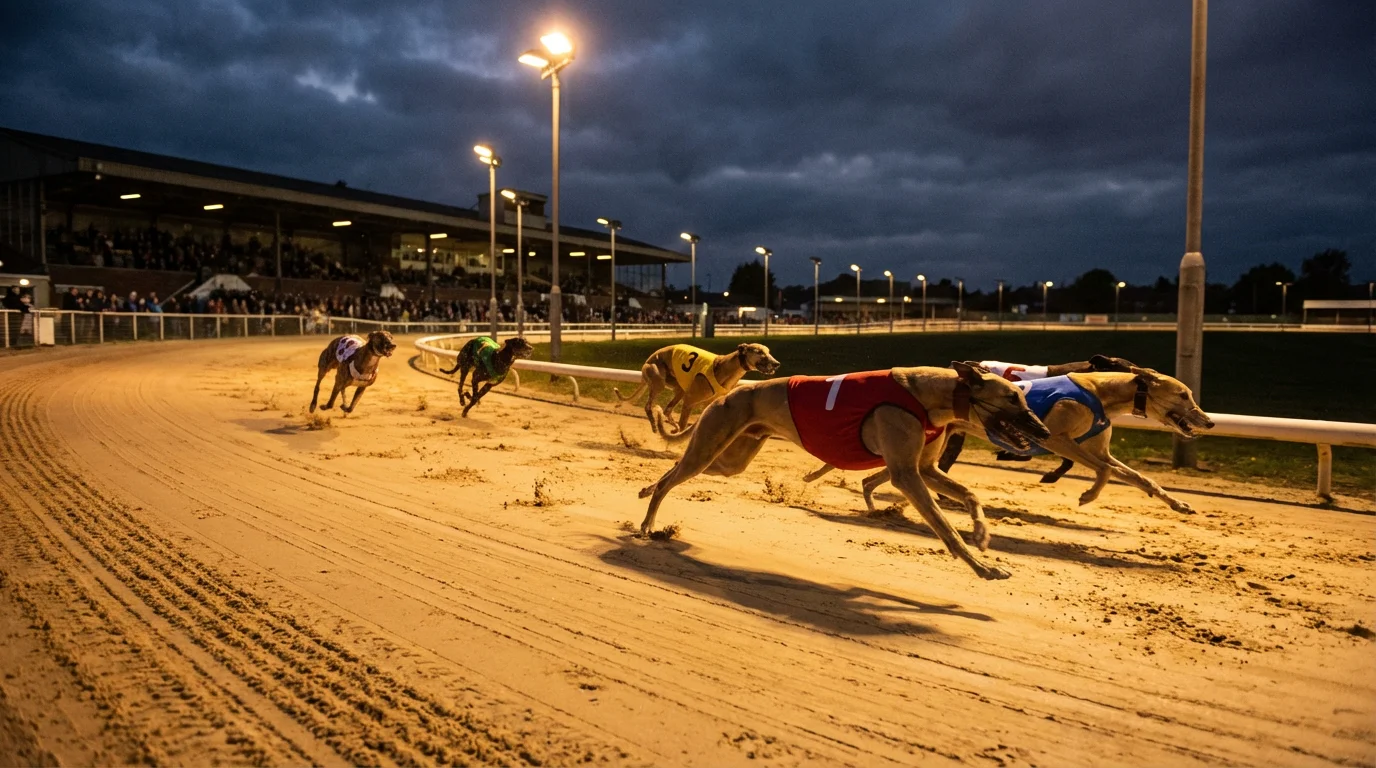
What Today's Greyhound Results Actually Tell You About Tomorrow's Bets
Most punters check greyhound results to see who won. That is the least useful thing a results page can tell you. The real edge is in how you read what happened — the finishing times, the starting prices, the sectional splits, the trap draws, the margin of victory. A winner at 1/6 who scraped home by a neck tells a very different story from a 5/1 shot that led from the first bend and won going away. Both are results. Only one is information.
Greyhound racing in the United Kingdom runs almost every day of the year, across 19 licensed GBGB stadiums from Newcastle down to Brighton and Hove. The Bookmakers Afternoon Greyhound Service provides a constant stream of midweek and daytime fixtures aimed squarely at the betting market, while evening and weekend cards draw in on-course crowds. The results from all these meetings are publicly available within minutes of each race finishing — through the GBGB's official feed, aggregator sites like Timeform, and the racecards built into every major bookmaker's platform.
What greyhound race results include: Each result typically displays the finishing positions of all six runners, their starting prices (SP), finishing times, sectional times where available, the forecast and tricast dividends, the official going report, and any stewards' comments on interference or non-runners. Together, these data points form the raw material for serious form analysis.
This guide is not a live results feed. What it is, instead, is the manual for turning those results into something actionable. We will walk through how UK greyhound racing is structured, how to dissect a racecard and a results page, what every major bet type involves, and how to build a strategy that does not rely on gut instinct or a lucky trap number. Whether you have been betting on the dogs for years or you are looking at your first racecard tonight, the aim is the same: fewer punts, better decisions, more informed risk.
A finishing position is a fact. What you do with it is a decision. The rest of this guide is about making that decision a good one.
How UK Greyhound Racing Works
Six dogs, a mechanical hare, and roughly 30 seconds of controlled chaos. That is greyhound racing in its most compressed description, and it is also wildly incomplete. The sport's apparent simplicity is what makes it attractive to casual spectators and dangerous for casual bettors. Understanding the mechanics underneath that simplicity is where the betting value lives.
Every race at a GBGB-licensed track follows the same fundamental structure. Six greyhounds are loaded into numbered traps — one through six, left to right as you face the first bend — and released simultaneously when the mechanical hare passes. The dogs chase the lure around an oval sand track, navigating two bends on a standard circuit or four on a longer staying trip. The first dog past the finishing line wins. Races are almost always six-runner affairs, though a late withdrawal can leave a vacant trap, which matters considerably for the remaining runners' racing lines.
Graded race — a standard race in which the Racing Manager assigns runners of similar ability to the same event, using the track's internal grading system (typically A1 through A11, with A1 being the highest class). Graded races form the bulk of every meeting card and are the bread and butter of BAGS racing.
The sport is regulated by the Greyhound Board of Great Britain, which licences tracks, registers greyhounds, and enforces the Rules of Racing. Every competing dog must be registered, microchipped, vaccinated, and cleared by an on-site vet before racing. Trainers hold individual licences and are subject to kennel inspections and routine doping controls. The last independent "flapping" track in the UK closed in early 2025, leaving GBGB as the sole regulatory framework for the sport in Great Britain.
The 2026 season carries particular significance: the centenary of organised greyhound racing in Britain, a hundred years since 1,700 spectators gathered at Belle Vue in Manchester on 24 July 1926 to watch a dog called Mistley win the very first race around an oval track. The GBGB is marking the milestone with a commemorative gala at Dunstall Park and a calendar packed with 50 category one competitions. For bettors, more high-quality opens means more races with transferable form and more opportunities to find value in dogs stepping up or down in class.
Racing meetings typically run between ten and fourteen races, each separated by roughly fifteen minutes. Morning and afternoon cards are broadcast through SIS to licensed betting offices, while selected evening fixtures and open races appear on Sky Sports Racing. The operational rhythm is relentless: results from one meeting feed directly into the grading decisions for the next, creating a constantly updating form cycle that rewards punters who stay close to the data.
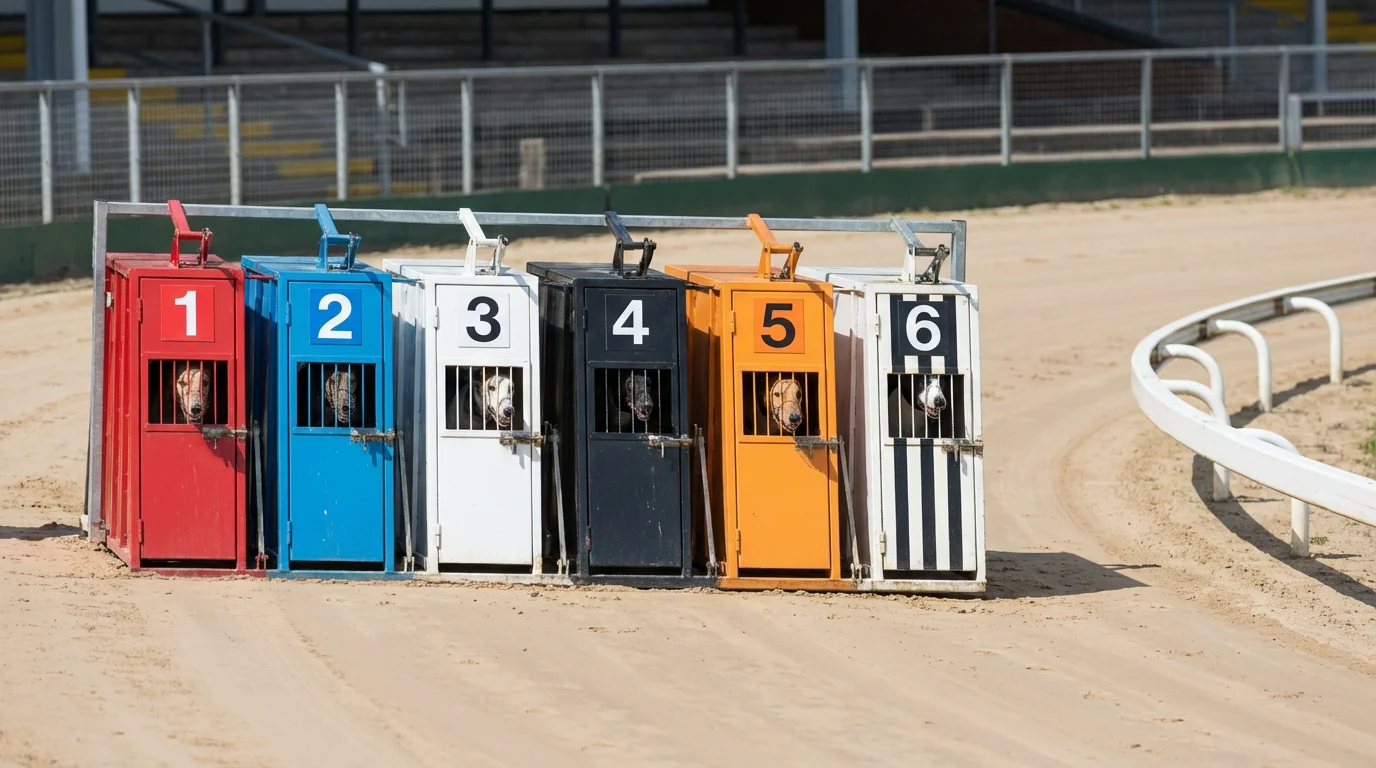
How the Grading System Shapes Every Race
The grading system is the engine room of greyhound racing, and most casual bettors ignore it completely. Every GBGB track operates its own internal grading ladder — usually A1 (top class) down to A11 or lower, depending on the depth of the kennel pool. A dog's grade is determined by its recent race performances at that track: win, and you go up; lose repeatedly, and you go down. The Racing Manager has discretion in seeding runners, but the grades broadly ensure that dogs of comparable ability race against each other.
This matters for betting because grade movements are predictable. A dog dropping from A3 to A5 after a couple of poor runs may simply have been racing above its natural level. Now back among its peers, it becomes a far more attractive proposition — and the market sometimes takes a race or two to catch up. Conversely, a dog that has won two on the bounce in A7 will be raised to A5 or A6, where it faces stiffer competition. The question is not whether it can win again, but whether it can win at the new level. The grading cycle is constant, and understanding where a dog sits in that cycle gives you information the starting price alone does not.
Open races operate outside the grading system. These invitation-only or entry-based competitions carry the biggest prize money and attract the strongest fields. Open form is generally more reliable than graded form because opposition quality is consistently high, but the betting markets are also sharper, making value harder to locate.
Race Distances and What They Demand
Not all races are the same distance, and distance shapes everything — running style, trap importance, and how you evaluate form. UK greyhound races fall into three broad categories. Sprint races cover roughly 260 to 285 metres, standard races run at around 450 to 500 metres (the most common distance by far), and staying races stretch to 630 metres or beyond, sometimes exceeding 700 metres at tracks with longer circuits.
Sprint races are over in under seventeen seconds. Early pace is everything: the dog that breaks fastest from the traps and leads into the first bend almost always wins. Trap draw matters enormously in sprints because there is no time to recover from a slow start or a bumped run. Standard-distance races, typically around 480 metres at most tracks, offer slightly more scope for a dog to recover from trouble at the first bend, but front-runners still dominate statistically. Staying races are the most tactical — dogs with sustained pace and the stamina to maintain speed through four bends are different athletes from pure sprinters, and the form book reflects that. A dog with brilliant sprint form may be entirely useless over 630 metres, and vice versa. Always check the distance before you check the form.
Reading Greyhound Race Results Like a Bettor
A greyhound results page is not a scorecard — it is a diagnostic report. Every number on it answers a different question, and the punters who treat results as raw data for future decisions consistently outperform those who just check whether their dog came in.
The core data points on a standard results page are: finishing order, starting prices, finishing time, sectional time (where recorded), distances between runners, trap numbers, going report, and any stewards' comments. Forecast and tricast dividends are also shown, which tell you how the Tote pools distributed for exotic bets. Each of these data points has a purpose beyond the immediate race.
Take finishing margins. A dog that wins by five lengths in a graded A4 race has announced it is probably too good for that grade — useful intelligence for the next card. Equally, a dog beaten two lengths into fourth in an open race has run far better than the same margin would suggest in an A9. The same finishing position can mean entirely different things depending on class, winner quality, and whether interference was noted.
Worked example — reading a result line:
Trap 4, "Ballymac Dozer," finishes 1st. SP: 5/2. Time: 29.43. Sectional: 3.87.
You backed this dog at 5/2 with a £10 win stake. Your return is £35 (£25 profit plus your £10 stake). But the real takeaway is the 3.87 sectional — a fast first split suggesting this dog led from the boxes. If the going was standard and the time is competitive for A3 at this track, you are looking at a potential improver. If the sectional was slow but the finishing time was fast, the dog ran on strongly from behind, which tells a different story about its running style and preferred position.
Results are not retrospective trophies — they are forward-looking instruments. A punter who reviews the previous night's card with a notebook, flagging dogs that ran well in defeat or won with something in hand, is building a database of future bets. The results page gives you everything you need, provided you know which numbers to focus on.
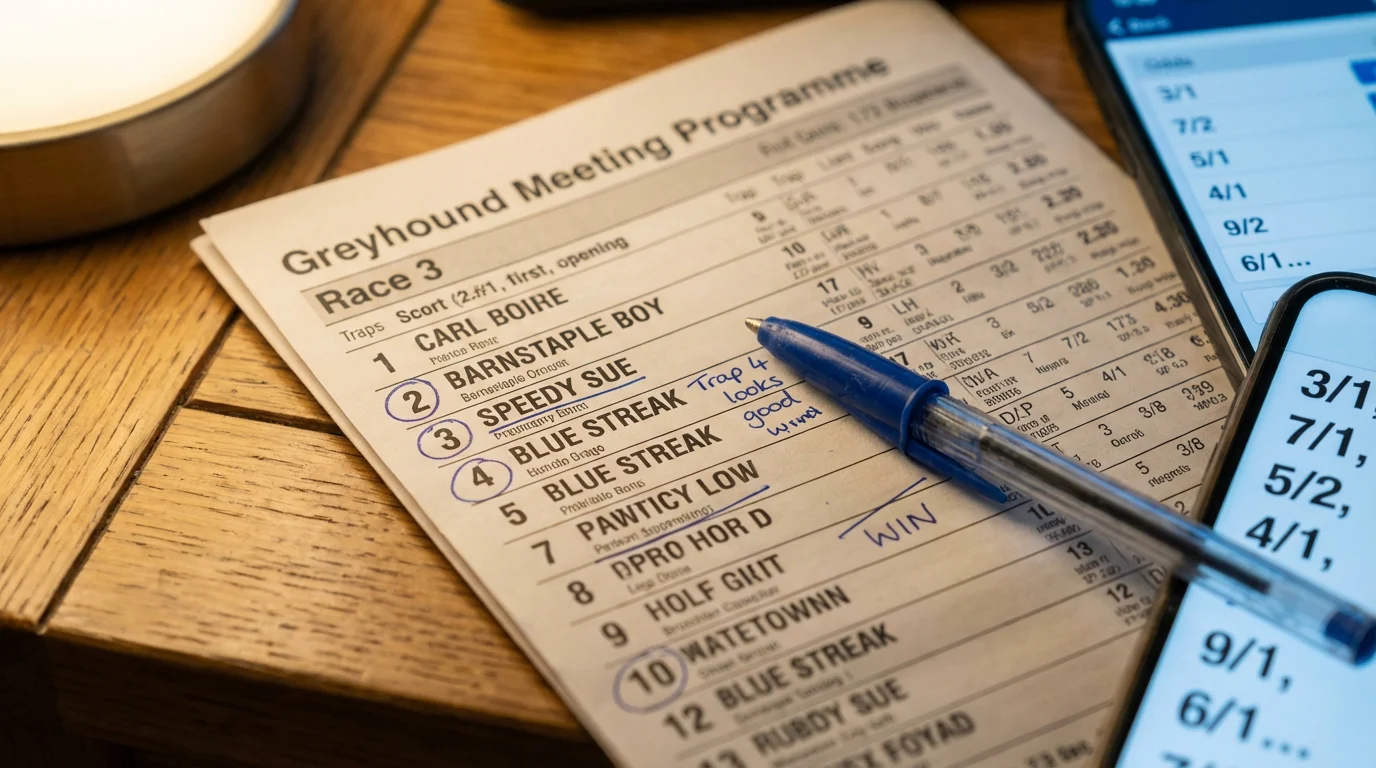
Starting Prices and What They Reveal
The starting price is the final odds offered by the on-course bookmaker at the moment the traps open. It is not the same as the early price you might have taken that morning, nor is it the Betfair Starting Price (BSP), which is determined by exchange activity. The SP reflects the aggregate weight of money in the on-course market, and it carries information about how the betting public — including professional punters with trackside intelligence — assessed each dog's chances.
When reviewing results, the SP column tells you more than what the winner paid. Compare the SP to the early-morning tissue price. A dog that opened at 4/1 and went off at 6/4 has been heavily backed — possibly by connections who saw a strong trial. A dog that drifted from 2/1 to 5/1 has seen money move away, which may indicate a concern not visible on the racecard. Neither pattern guarantees an outcome, but tracking SP movements over time helps you understand how the market prices form, and where it might misprice it.
Tracking SP movements over time reveals patterns that raw form does not. You might notice that a particular trainer's dogs are consistently shorter in the market than their recent form warrants — suggesting insider confidence. Or you might find that early-morning drifters at a specific track underperform relative to their tissue price. These edges are small, but they compound across a season of disciplined record-keeping.
Finishing Times and Sectional Splits
Finishing times are affected by the going, wind, hare run quality, and race pace. A raw time in isolation is almost meaningless — 29.40 at Romford and 29.40 at Towcester are entirely different performances because the tracks have different circumferences and bend profiles. Comparisons must always be made within the same track and, ideally, within the same going conditions.
Sectional times add a layer of granularity that finishing times alone cannot provide. The first sectional — the time from trap to a fixed point, usually the first bend — measures early pace and trap break speed. A dog with a consistently fast first split is a confirmed front-runner, which matters enormously for assessing how it will handle a particular trap draw. The run-home split, calculated by subtracting the sectional from the overall time, indicates stamina and late speed. A dog with a slow first split but a fast run-home is a closer that relies on finding racing room late in the contest. These distinctions shape everything from bet selection to trap analysis.
Calculated times strip away variables like the going and hare speed to produce a standardised rating. Timeform's greyhound ratings use this method, and they are among the most reliable tools for comparing dogs across tracks and conditions. If a results page does not provide calculated times, you can approximate by comparing a dog's time against the average winning time for its grade at that track on the same card.
Greyhound Bet Types — From Singles to Tricasts
Before you pick a dog, decide what kind of bet matches your conviction. The greyhound betting menu is deeper than most newcomers expect, running from straightforward win bets through to combination tricasts that demand precision across three finishing positions. Each bet type carries a different risk-reward profile, and choosing the wrong structure for your level of confidence is one of the most common ways to leak money.
Every greyhound bet falls into one of three categories: single-outcome bets (win, place, each way), multi-position bets (forecasts and tricasts), and accumulative bets (doubles, trebles, patents, Yankees). Single-outcome bets are where most punters should concentrate most of their bankroll — they are the easiest to evaluate, the simplest to settle, and they produce the clearest feedback loop. Multi-position bets offer larger payouts but demand proportionally higher precision. Accumulators are entertaining, occasionally spectacular, and structurally disadvantageous over the long term.
The table below summarises the core bet types. We will go deeper into each category in the sections that follow.
| Bet Type | What You Need | Typical Use Case |
|---|---|---|
| Win | Your selection finishes 1st | Strong conviction on a single dog |
| Place | Your selection finishes 1st or 2nd | Confident but hedging against interference |
| Each Way | Two bets: one win, one place | Value at longer odds with place insurance |
| Straight Forecast | 1st and 2nd in exact order | Strong view on two dogs' relative ability |
| Reverse Forecast | 1st and 2nd in either order | Confident in two dogs, less sure who wins |
| Tricast | 1st, 2nd, and 3rd in exact order | High risk, high reward, strong form read |
| Combination Tricast | 1st, 2nd, 3rd in any order | Three strong selections, flexible finishing |
| Accumulator | Multiple selections all win | Small stake, big potential return, low probability |
Straight Forecast
- One bet: two dogs must finish 1st and 2nd in the exact order you specify
- Lower stake cost (single unit)
- Higher payout per unit staked
- Requires precise judgement on which dog beats the other
- Best used when one dog is a standout and you have a strong second pick
Reverse Forecast
- Two bets: your two dogs finish 1st and 2nd in either order
- Double the stake of a straight forecast
- Lower payout per unit because you are covering both permutations
- More forgiving — you do not need to call the exact finishing order
- Best used when two dogs are closely matched and either could lead
Win, Place, and Each Way
A win bet is the foundation. You pick a dog, it wins, you collect. The odds reflect the market's assessment of probability: a dog at 2/1 is priced as having roughly a 33% chance, a dog at 5/1 around 17%. The bookmaker's margin inflates the total implied probability of all six runners to somewhere between 115% and 130%, which is where the house edge lives. Your job is to find dogs whose actual chance of winning exceeds the probability implied by the price.
Place betting on greyhounds typically pays out if your dog finishes first or second. With only six runners, the place market is tight. Place odds are usually one-third to one-quarter of the win price, which means place betting on short-priced favourites rarely offers value — a dog at evens for the win might be 1/3 for a place, requiring a 75% probability just to break even.
Each way betting combines one win bet and one place bet at equal stakes, so a £5 each way bet costs £10 total. The place part is paid at a fraction of the win odds — typically one-quarter for greyhound racing. Each way makes mathematical sense at longer odds, where the place fraction still returns a meaningful profit if the dog runs second. At short prices, each way is usually a poor proposition because the place portion returns less than your total stake. A useful rule of thumb: consider each way only when your selection is 4/1 or longer and you genuinely believe it has a strong chance of finishing in the first two.
Forecasts, Tricasts, and Combination Bets
Forecast and tricast bets are where greyhound betting gets genuinely interesting — and genuinely difficult. A straight forecast requires you to name the first and second finishers in exact order. The dividend is calculated by the Tote (or the bookmaker's computer straight forecast) based on the actual finishing combination, not on pre-race odds. This means forecast returns can vary enormously: a 1/2 favourite beating the 3/1 second favourite might return £5 for a £1 stake, while a 10/1 outsider beating another outsider could return £80 or more.
A combination forecast covers all possible finishing orders between your selected dogs. Picking three dogs in a combination forecast creates six bets — every permutation of two from three. This multiplies your stake by six but significantly increases your chance of landing the bet. Flexibility costs money, but it buys a wider margin for error.
Tricasts extend the principle to three finishing positions. A straight tricast — first, second, and third in exact order — is the longest shot on the standard greyhound betting menu and can return extraordinary dividends. Combination tricasts select three or more dogs and cover all permutations across the first three places. Picking three dogs gives you six combination tricast bets; picking four gives you twenty-four. The maths escalates quickly, so cost control matters. Tricasts reward bettors who can confidently eliminate the weakest runners in a race rather than those who try to predict exact order. If you can narrow a six-dog field to three realistic contenders, a combination tricast becomes a much more focused and affordable proposition.
The Greyhound Form Guide — Your Pre-Race Weapon
Form is not history — it is an argument about what might happen next. Every form guide is a compressed record of a dog's recent performances: where it ran, what grade, what trap, how it broke, and how it finished. Reading form is the single most important skill in greyhound betting, and it is what separates serious punters from those who pick a name or a trap number.
A form guide gives you enough information to reconstruct a dog's recent race experiences without having watched them. From that reconstruction, you make inferences about how the dog will perform given the trap draw, the going, the distance, and the opposition. The best form readers are not reading backwards — they are projecting forwards.
Trap Number
The starting position (1–6). Inside traps (1–2) suit dogs that rail, outside traps (5–6) suit wide runners. A mismatch between running style and trap can be a decisive disadvantage.
Recent Form Figures
A sequence of finishing positions from recent races, read left to right (most recent last). "3 2 1 1" tells you a dog is improving. "1 1 4 6" suggests a dog in decline or facing tougher company.
Finishing Time
The official time for the dog's most recent runs. Compare within the same track and distance — cross-track comparisons require calculated ratings or careful adjustment.
Trainer
The licensed trainer responsible for the dog's preparation. Trainer strike rates at specific tracks are a significant, and often overlooked, form factor.
Weight
Recorded at kennelling before each race. Consistent weight suggests a dog is in stable condition. A sudden drop or gain may indicate fitness issues or a change in training regime.
The form guide is your pre-race weapon, but it works best when you use it systematically rather than glancing at it for quick impressions. In the sections below, we break down how to read the racecard line by line and how trap statistics can give you an additional angle that pure form alone misses.

How to Read a Greyhound Racecard
A greyhound racecard packs an enormous amount of information into a tight format, and knowing how to unpack it is the difference between an informed bet and a guess. Every racecard — whether on a bookmaker's website, in the Racing Post, or on the printed card at the track — follows a broadly similar layout, though the depth of detail varies by source.
At the top of each race entry you will find the race header: the time of the race, the track, the distance, the grade, and the prize money. The grade is critical — it tells you the class of opposition. Below the header, each of the six runners is listed by trap number, with the dog's name, trainer, sire and dam (breeding), weight, season (for bitches), age, and form figures. The form figures are the most important single element on the card.
Form figures in greyhound racing consist of a string of numbers and letters representing recent finishing positions and race comments. The numbers 1 through 6 denote finishing position. The letter "m" indicates the dog was involved in a move or bumped. An "F" denotes a fall, "T" a trap failure. Symbols vary slightly between sources, but the pattern is universal: the sequence reads from oldest (left) to most recent (right). A line of "1 1 2 1 3" tells you the dog wins regularly but is not unbeatable. A line of "6 5 6 6 4" tells you to look elsewhere.
Better racecards include race comments — brief textual descriptions of how the dog ran. Phrases like "led from trap," "bumped first bend," "ran on well," or "faded final straight" are invaluable shorthand. A dog repeatedly described as "bumped first bend" from a particular trap may do considerably better from a cleaner draw. Race comments, combined with sectional times, let you separate bad luck from bad ability — a distinction that the raw finishing positions alone cannot make.
Trap Statistics and Track Bias
Every greyhound track has its own trap biases, and ignoring them is like ignoring the draw in flat horse racing. Trap statistics measure the win rate of each box number over a large sample at a specific track. The biases arise from track geometry: bend tightness, distance from traps to the first bend, and hare rail position all influence which trap numbers have a natural advantage.
At most tracks, trap one and trap six tend to have the strongest win rates — trap one because the rails runner has a clear inside passage through the first bend, and trap six because the wide runner can sweep around the outside without interference. The middle traps (three and four) typically suffer the lowest win rates because those dogs are squeezed on both sides at the first bend, making them vulnerable to crowding. These are generalisations, though, and specific tracks deviate. The 2025 data from OLBG, for instance, showed trap one at Towcester producing a roughly 20% strike rate, while trap six at Harlow achieved 21% — both significantly above the 16.7% baseline you would expect from a perfectly even six-trap race.
The practical application is simple: when two dogs look equally appealing on form, the one drawn in the statistically favourable trap at that specific track should get the nod. Conversely, a strong form dog drawn in a historically weak trap deserves a discount, not a dismissal, but a recalibration of the odds in your head. Trap statistics do not replace form analysis — they supplement it with a structural factor that the racecard alone does not reveal.
Building a Greyhound Betting Strategy That Holds Up
Strategy is not a magic system. It is a repeatable process for making less-wrong decisions. The punters who survive long-term in greyhound betting are not the ones who found a secret formula — they are the ones who built a disciplined process and stuck to it through the inevitable losing runs.
The foundation of any greyhound betting strategy is selectivity. There are hundreds of races every week across UK tracks, and most should not interest you. A profitable approach begins with identifying races where you have a genuine opinion — based on form, trap draw, track knowledge, or trainer insight — and passing on everything else. A 25% strike rate on carefully chosen bets will always outperform a 15% strike rate on indiscriminate punting.
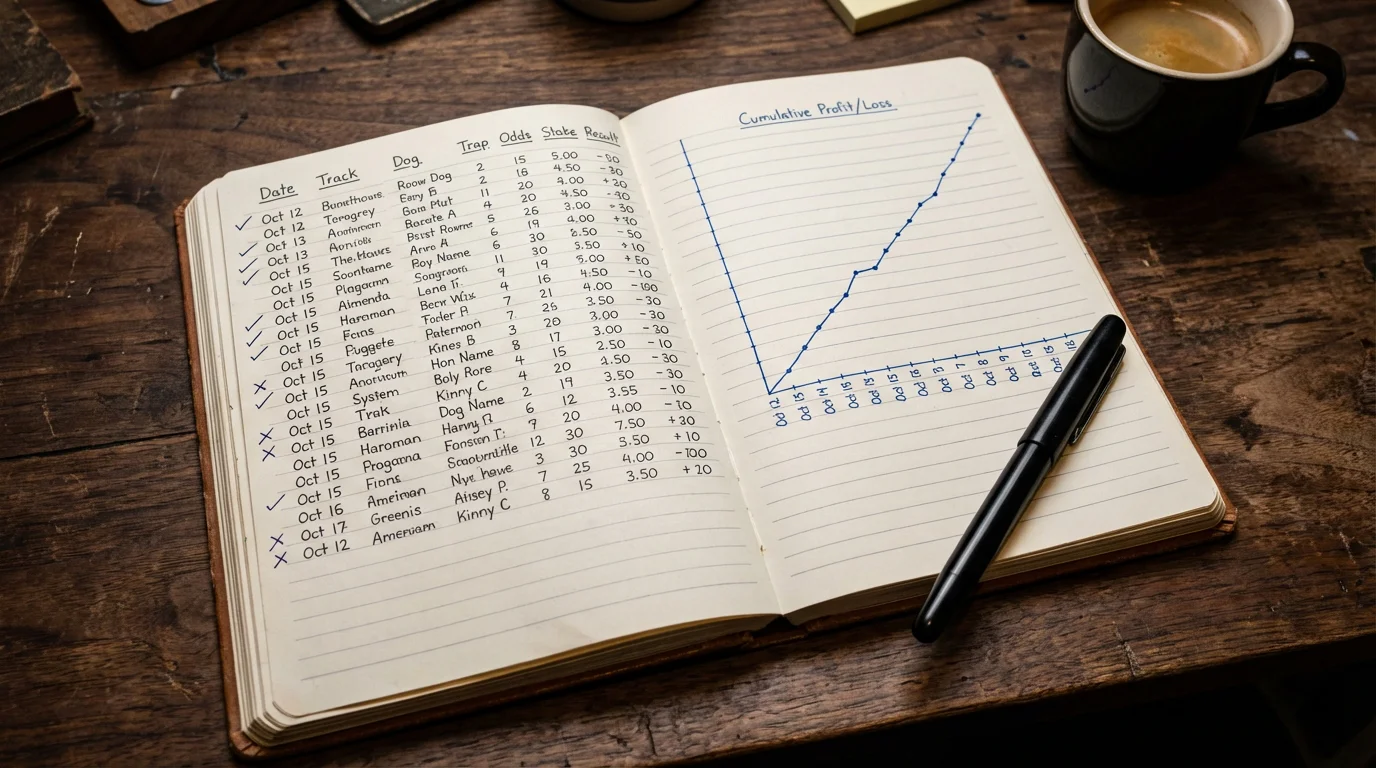
Beyond selectivity, a strategy needs three things: a method for identifying value, a staking plan that protects your bankroll, and a record-keeping system that lets you evaluate your performance. The record-keeping part is non-negotiable: if you do not track your bets, you cannot know whether your method works or whether you are simply getting lucky.
Do
- Specialise in one or two tracks where you can build deep knowledge of the kennels, the biases, and the grading cycle
- Set a monthly bankroll and divide it into units — never bet more than 2–3% of your bankroll on a single race
- Record every bet: date, track, race, dog, trap, odds taken, stake, and result. Review weekly
- Watch race replays, not just results — the running line often tells a different story from the finishing positions
Don't
- Chase losses by increasing stakes after a bad run — this is the fastest way to destroy a bankroll
- Follow anonymous tipsters or social media "NAPs" without understanding the reasoning behind the selection
- Use progressive staking plans like the Martingale — they only work in theory, and in practice they lead to catastrophic loss
- Bet on every race at a meeting just because you are watching it — selectivity is a weapon, not a weakness
Spotting Value in Greyhound Markets
Value is the most overused and least understood word in betting. In greyhound racing, value means one thing: backing a dog at odds that are higher than the dog's actual probability of winning. If you assess a dog as having a 30% chance of winning and the market offers you 4/1 (an implied probability of 20%), that is a value bet. If the same dog is offered at 2/1 (33% implied), it is not — even though you think it will probably win.
Finding value requires you to form your own prices before looking at the market. Study the racecard, consider the trap draw and track bias, evaluate the sectional times and recent form, and arrive at your own probability estimate for each dog. Only then compare to the available odds. If your figure suggests value, you bet. If it does not, you pass. Value is a long-term proposition, not a single-race one. Over a hundred bets, the maths works. Over five bets, anything can happen.
Results & Staking Toolkit
Three tools built from the guide’s own staking, value-finding, and exchange-pricing maths.
Flat stakes take the same £ amount every bet, so a long losing run can wipe out — or go negative past — your bankroll. Percentage staking takes a fixed share of whatever is left, so it mathematically approaches zero but never actually reaches it.
Value only exists when your own probability estimate is higher than the market’s implied probability. This mirrors the guide’s own example: rating a dog at 30% and finding it priced at 4/1 (20% implied) is a value bet — the same dog at 2/1 (33% implied) is not, even though it is more likely to win outright.
Exchange odds are often bigger than bookmaker prices, especially on outsiders, but the standard 5% commission on net winnings eats into that edge. This tool compares the two after commission so you can see which route actually pays more on the day.
One practical shortcut: focus on dogs whose form has been disrupted by bad luck rather than bad ability. A dog that has been bumped three times in recent runs, dropped a grade, and is now drawn in a clear trap at a track where that trap wins 20% of the time is exactly the kind of candidate the market undervalues. The results page shows a string of mid-field finishes; the race comments tell you why. That gap between the surface story and the underlying one is where value lives.
Staking Plans and Bankroll Discipline
Your staking plan matters more than your selection method. That is a deeply unpopular statement among punters who pride themselves on picking winners, but it is demonstrably true. A 30% strike rate with disciplined level stakes will outperform a 35% strike rate with erratic, emotion-driven staking every time. The reason is simple: bad staking amplifies losing runs and compresses winning ones. Good staking smooths the variance and lets your edge — however small — express itself over time.
Level stakes is the simplest and most effective approach for most greyhound bettors. You decide on a fixed unit — say, £10 or 2% of your bankroll — and you stake that amount on every qualifying bet, regardless of how confident you feel. This removes the temptation to "go big" on certainties (which are never certain) and prevents the emotional spiral of increasing stakes to recover losses. It is boring. It works.
Percentage staking is a more sophisticated variant. Instead of a fixed monetary unit, you stake a fixed percentage of your current bankroll — typically 1% to 3%. Your stakes increase as your bankroll grows and decrease as it shrinks, providing a natural brake against catastrophic loss. It makes it mathematically impossible to go bust in a single losing run, provided you stick to the percentage.
Avoid the Martingale system and any variant that requires doubling your stake after a loss. A run of five consecutive losers — which happens far more often than most punters expect — turns a £10 starting stake into a £320 recovery bet. That is not strategy; it is desperation dressed in arithmetic.
How Greyhound Odds Work — SP, BSP, and the Market
Odds are not predictions — they are prices. And like any price, they can be wrong. Understanding this distinction is the single most important conceptual shift a greyhound bettor can make, because it reframes the entire activity. You are not trying to predict winners. You are trying to find mispriced dogs.
UK greyhound odds are most commonly expressed in fractional format: 5/2, 3/1, 11/4, and so on. The first number is your profit per unit of the second number staked. A dog at 5/2 returns £5 profit for every £2 you stake, plus your stake back — so a £2 bet returns £7 total. Decimal odds, increasingly common on online platforms, express the total return per unit staked: 5/2 in fractional is 3.50 in decimal (£1 stake returns £3.50). Implied probability converts odds into a percentage: divide 1 by the decimal odds. A dog at 3.50 (5/2) has an implied probability of 28.6%.
Fractional
3/1
Decimal
4.00
Implied Probability
25%
The starting price (SP) is determined by on-course bookmakers at the moment the traps open. The Betfair Starting Price (BSP) is determined by matching exchange bets at the off, and is often different from the traditional SP — particularly in races with thin exchange liquidity. For most online punters, the practical question is whether to take an early price, wait for the SP, or use the exchange. Early prices lock in a known return but sacrifice flexibility. BSP can offer superior value, especially on less-fancied runners, but exchange commission (typically 5%) eats into returns.
The overround — the total implied probability of all runners — tells you how much margin the bookmaker builds into each race. Greyhound markets typically carry an overround of 115% to 130%, higher than horse racing and significantly higher than football. That margin is the tax you pay for every bet, and it means you need a genuine edge just to break even.
UK Greyhound Tracks at a Glance
Nineteen licensed tracks, each with its own personality and its own trap biases. That is the landscape of UK greyhound racing in 2026, and it is a landscape that has been shrinking steadily. The GBGB currently oversees 19 licensed stadiums, running from Newcastle in the north-east to Brighton and Hove on the south coast, with one track in Wales at Valley, Ystrad Mynach — although the Welsh venue's future is uncertain as the Senedd continues progressing the Prohibition of Greyhound Racing (Wales) Bill through its legislative stages.
The major BAGS tracks — Romford, Crayford, Monmore Green, Sunderland, Central Park, Henlow, and Harlow among them — provide daytime racing to betting shops and run high volumes of graded races. Their grading cycles are tight and the form book constantly refreshes, making them natural territory for the form student. Evening and weekend meetings at Towcester, Nottingham, and Doncaster feature more open-race activity and stronger fields, which suits bettors who prefer quality over quantity.
Track knowledge is one of the most underrated edges in greyhound betting. Each stadium has its own circumference, bend profiles, sand depth, and hare type. Romford is tight and sharp, heavily favouring early-pace dogs. Towcester is one of the largest and fairest circuits, where wide galloping bends reduce trap bias and give closers more scope. Monmore Green is fast, Sunderland generally fair, Nottingham favours the inside traps on its standard 480-metre distance. These differences fundamentally alter the probability of any given dog winning.
Pick one or two tracks and learn them thoroughly. Study the trap stats, watch the replays, note which trainers dominate, and understand how the grading manager operates. Specialists outperform generalists in greyhound racing precisely because track-specific knowledge is so decisive.
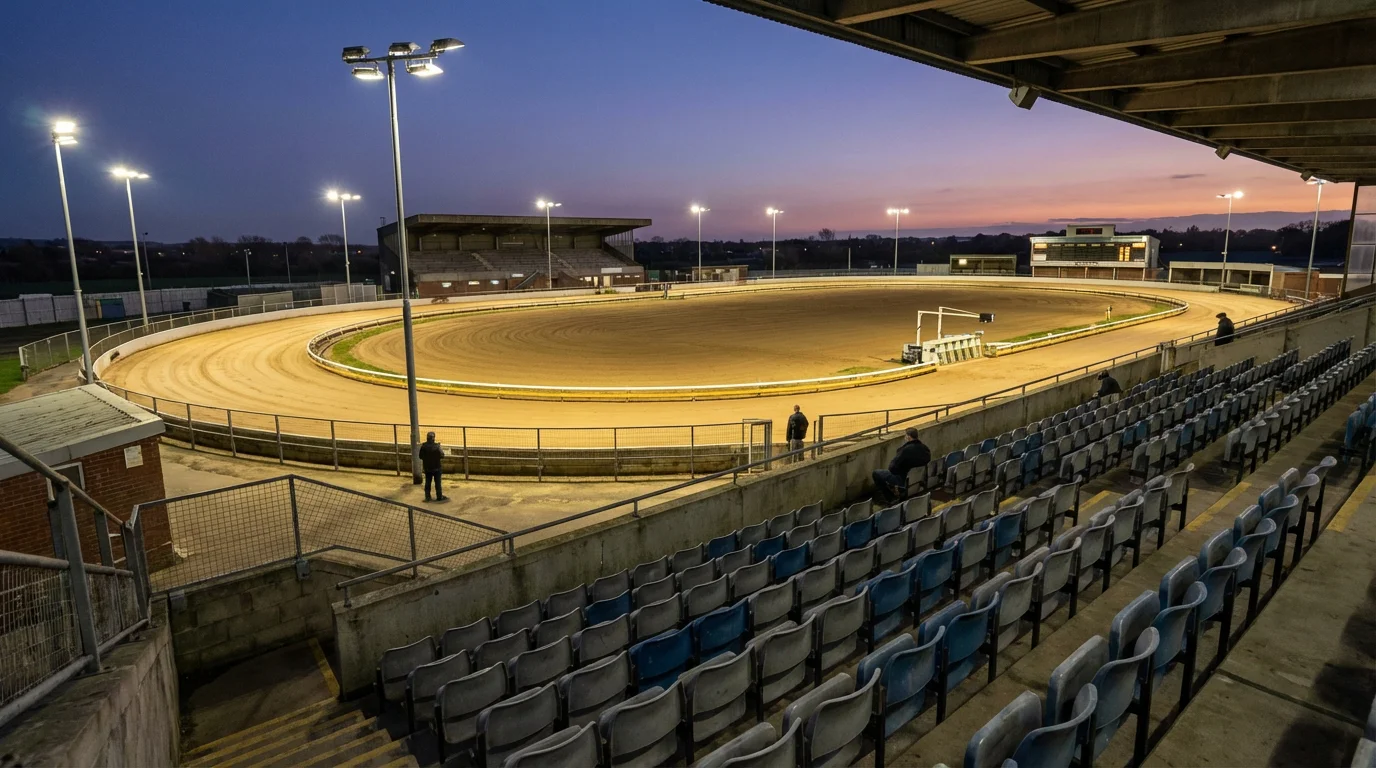
Track knowledge eliminates bad bets before you even open a racecard.
Where to Bet on Greyhounds Online
Not every bookmaker treats greyhound punters the same. Some operators offer comprehensive coverage with live streaming, form guides, and dedicated markets. Others treat the dogs as an afterthought — a few BAGS races listed with minimal data and lagging odds. Choosing the right bookmaker is a strategic decision, not just a matter of sign-up offers.
The key features to evaluate are: greyhound-specific market depth (do they price up every GBGB meeting, or just selected races?), live streaming availability (SIS and RPGTV feeds are the standard — some bookmakers offer them free to funded accounts, others require a qualifying bet), Best Odds Guaranteed (BOG), and the speed and accuracy of their results service. BOG is particularly important for greyhounds. If you take an early price and the SP is higher, a bookmaker with BOG pays you at the better price. Not all operators extend BOG to greyhound racing — many limit it to horse racing — so check before you commit.
Exchange betting through Betfair is an alternative worth considering. The exchange model lets you back and lay at user-set odds, which often produces better prices — particularly on outsiders, where the bookmaker's overround is most inflated. The trade-off is lower liquidity in greyhound markets compared to horse racing and a 5% standard commission on net winnings. For punters interested in lay betting — backing dogs to lose — the exchange is the only viable platform.
Most serious greyhound bettors maintain accounts with multiple bookmakers to ensure they can always take the best available price. Over a thousand bets, the cumulative advantage of consistently shopping for the best odds is significant — this is not arbitrage, just basic price discipline.
Before committing to a bookmaker for greyhound betting: Verify that they offer greyhound-specific promotions and Best Odds Guaranteed on dog racing, not just horses. Check that live streaming covers the tracks you follow. And read the terms on any free bet offers — wagering requirements on greyhound bets are sometimes different from other sports.
Greyhound Betting — Your Questions Answered
Three questions that come up every single raceday. If you are new to greyhound betting, start here. If you are not, you might still learn something.
How do I read a greyhound racecard?
A greyhound racecard lists the race time, track, distance, and grade at the top, followed by six entries — one per trap. Each entry shows the dog's name, trainer, weight, and form figures (recent finishing positions, oldest to most recent). A string like "2 1 1 3 1" indicates a consistent performer. Letters carry specific meanings: "F" for a fall, "T" for a trap failure, "m" for bumped during the race. The grade tells you the class of opposition, and the trap number tells you the starting position. Start by reading the form figures, cross-reference with the trap draw and track-specific bias data, then check race comments for signs of trouble in running that raw positions do not capture.
What trap wins most in greyhound racing?
Across the UK as a whole, trap one and trap six tend to produce the highest win rates, while traps three and four generally produce the lowest. Trap one gives the rails runner a clear inside passage into the first bend; trap six gives the wide runner open space around the outside. Middle traps are more exposed to crowding. However, figures vary significantly by track — published trap statistics from sites like OLBG or Greyhound Stats UK, updated annually, are the best source for current data. The baseline expectation in a six-trap race is 16.7% per trap; anything consistently above that represents a genuine bias worth factoring into selections.
How does each way betting work on greyhounds?
An each way bet is two separate bets of equal value: one on your selection to win and one to place (finish first or second in greyhound racing). If your dog wins, both parts pay out — the win part at full odds, the place part at one-quarter of the odds. If your dog finishes second, you lose the win part but collect the place portion. If it finishes third or worse, both bets lose. Each way value tends to emerge at longer odds — generally 4/1 or above. At shorter prices, the place return is too slim relative to total outlay. A £5 each way bet costs £10. If the dog wins at 6/1, you receive £30 win profit plus £7.50 place profit plus your £10 stake back, totalling £47.50.
The Dog That Doesn't Bark — What Results Can't Show You
There is a reason the best greyhound punters watch races on mute — they are reading the track, not the commentary. And there is a reason the best form readers spend as much time studying defeats as victories. Results tell you what happened. They do not tell you why it happened, and they certainly do not tell you what will happen next with any certainty.
A dog's form line might read "6 5 4 3" and the untrained eye sees a consistent loser. The experienced eye sees a dog improving with every run, possibly recovering from injury or settling into a new kennel. The results page shows finishing positions; it does not show the slow-healing muscle strain, the change in feeding regime, or the trainer's decision to trial at a different distance. These invisible factors are everywhere in greyhound racing, and they are why pure statistical models will always have a ceiling.
This does not mean form analysis is futile. It means it is necessary but not sufficient. The greyhound punter who combines systematic form reading with track knowledge, trap statistics, and an understanding of market pricing will find themselves ahead of the curve more often than not. The punter who relies on any single tool will eventually be found out.
Greyhound racing is entering its second century in Britain. The sport that began with 1,700 spectators watching a dog called Mistley run 440 yards around a Manchester sand track now generates over a billion pounds in annual betting turnover and produces racing nearly every day of the year. The English Greyhound Derby returns to Towcester this spring, with the first round on 30 April and a prize of £125,000 awaiting the winner of the final on 6 June. The centenary celebrations will be loud, nostalgic, and well-attended. The smart money, as always, will be quiet — buried in the form books, the sectional times, and the race comments that most spectators never bother to read.
Check the results tonight. But read them properly. That is where the edge begins.
