

The Screen That Changed Greyhound Betting
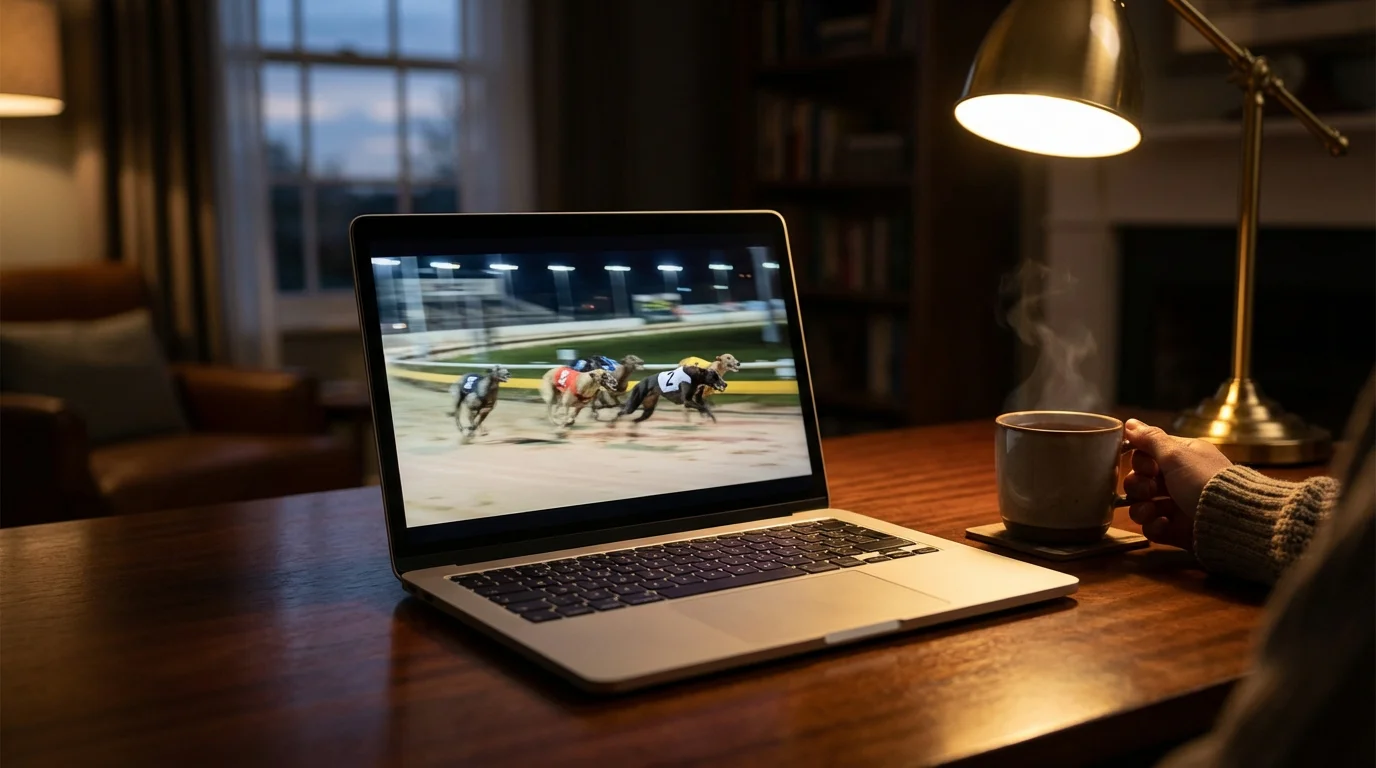
There was a time when the only way to watch a greyhound race was to be at the track. You stood on the terraces, watched the hare come around, and judged with your own eyes whether your dog broke cleanly or got bumped into the second bend. That era is over. Live streaming through bookmaker platforms and broadcast services has made it possible to watch virtually every licensed UK greyhound meeting from a phone, tablet, or laptop — and it has quietly transformed how informed punters approach the sport.
Watching races live is not entertainment bolted onto the betting experience. It is a form-reading tool. Racecards tell you what happened in shorthand — positional figures, trouble codes, finishing times. A live stream shows you how it happened: the dog’s body language in the traps, whether it broke alert or hesitant, how it handled the bends, whether it was ridden for speed or settled into a cruising stride. These observations are invisible in the data and unavailable to the punter who only reads the card. If two bettors are studying the same racecard but one watched the previous races live, the watcher has information the reader does not.
Access to live greyhound streaming in the UK comes through three main channels: bookmaker platforms, the SIS broadcast network, and occasional Sky Sports coverage of major events. Each has different access requirements, coverage levels, and quality standards. Knowing which channel serves your needs — and what it costs — is the first step to integrating live watching into your betting process.
Stay updated at greyhoundresultstoday.
Free Streaming via Bookmakers
The most common way to watch live greyhound racing online is through a UK-licensed bookmaker. Most major operators offer streaming of UK greyhound meetings through their website or mobile app, sourced from the SIS feed that provides the broadcast backbone for UK dog racing. The word “free” requires a small asterisk: you typically need either a funded account or a placed bet on the relevant meeting to unlock the stream. The exact requirement varies by bookmaker — some ask for a minimum account balance, others require a qualifying bet of as little as one pound on any race at the meeting.
The practical experience of streaming through a bookmaker is functional rather than cinematic. You get a camera angle covering the track, the hare, and the dogs — usually a wide shot from a fixed position that captures the traps, the first bend, and the finishing straight. Commentary is provided on most streams, though quality ranges from professional to barely audible. The video resolution is adequate for following the race but not always sharp enough to read individual body language in detail, particularly on mobile devices with smaller screens.
Stream delay is the single most important quality variable. All bookmaker streams run a few seconds behind real-time to prevent in-play exploitation. A delay of two to three seconds is standard and manageable. A delay of eight to ten seconds — which some bookmakers suffer during peak evening cards — is problematic if you are also following commentary or social media, because you will know the result before you see it. Test the delay during a few races before relying on a bookmaker’s stream as your primary viewing platform.
Coverage breadth also varies. The best bookmaker streaming services carry every GBGB-licensed meeting throughout the day, from afternoon matinees to late-evening cards. Others limit their greyhound streaming to selected meetings or prime-time evening fixtures. If you bet on afternoon cards or smaller tracks, verify that your bookmaker streams those meetings — not just the headline venues.
One advantage of bookmaker streaming that is easy to overlook: it embeds the stream within the betting interface. You can watch a race and study the racecard for the next race simultaneously without switching between apps or windows. For punters who use live watching as real-time form research — noting how a dog handled the bends before it runs again later on the same card — this integration is genuinely useful.
Sky Sports and SIS Coverage
SIS — Satellite Information Services — is the broadcast infrastructure behind UK greyhound racing coverage. SIS produces the live feeds that bookmakers license for their streaming services, and it also supplies the pictures shown on screens in betting shops across the country. If you have ever watched a greyhound race in a Ladbrokes, William Hill, or Coral shop, you were watching an SIS feed.
Direct access to SIS outside of a bookmaker platform or betting shop is limited for the average punter. SIS primarily operates as a business-to-business service, selling feeds to licensed operators rather than to individual consumers. The practical result is that bookmaker streaming is SIS content wrapped in a bookmaker interface — you are watching the same pictures regardless of which operator you use, just with different levels of delay, resolution, and interface polish around them.
Sky Sports provides television coverage of selected major greyhound events, but its commitment to the sport is modest compared to its horse racing output. You may see Derby finals, major open-race events, and occasional feature meetings broadcast live on Sky Sports Racing or as segments within broader sports programming. This coverage is valuable for the spectacle of big events but does not serve the everyday bettor who needs to watch Tuesday afternoon’s card at a midlands track. For regular race-by-race coverage, bookmaker streaming remains the reliable option.
RPGTV — the Racing Post’s greyhound television channel — has historically offered dedicated greyhound coverage with analysis, previews, and live racing. Availability of this service has changed over time, and it is worth checking current access options if you want a more analytical viewing experience than the raw SIS race feed provides. Where available, RPGTV offers context that a basic bookmaker stream does not: expert commentary, form discussion, and kennel updates that enrich the visual information you are absorbing from the race itself.
Why Watching Races Improves Your Betting
The betting edge from watching races live is not about catching something dramatic — a fall, a clearly hampered dog, an obvious miscarriage of justice. Those events are rare. The edge comes from the accumulation of subtle observations that racecards cannot capture. A dog that was coded “EvPc” in the form comment — even pace, no trouble — may have looked sluggish through the bends when you watched it live, carrying its head high and showing none of the drive you would expect from a fit, competitive runner. The form says nothing was wrong. Your eyes say the dog is not right.
Early pace assessment is another area where watching beats reading. The form might tell you a dog led at the first bend, but watching the race shows you whether it led because it broke brilliantly and powered clear, or because the other five dogs all missed the break and it happened to be marginally less slow. The distinction matters for predicting what will happen next time out. A genuinely fast breaker will replicate its early speed consistently. An accidental leader produced by a poor-breaking field will not.
Bend running is the observation that separates the watchers from the readers most clearly. How a dog navigates bends — whether it rails tight, drifts mid-track, or swings wide — determines its chances in a way that sectional times only partially capture. A dog that runs a beautiful racing line through the bends, hugging the rail and losing no ground, is mechanically efficient in a way that translates to future performance. A dog that sprawls wide through every turn is burning energy and covering extra distance. You can infer some of this from form codes like “W” or “Rls,” but watching the actual movement gives you a precision that abbreviations cannot match.
The compounding effect matters most. Watching one race teaches you very little. Watching fifty races at the same track teaches you how that track rides: where the crowding happens, which traps produce clean runs, how the surface affects movement in different weather. This track-specific visual knowledge combines with racecard analysis to produce assessments that are richer and more accurate than either source alone.
Eyes On, Volume Off
There is an old line among experienced greyhound punters: watch the races with the sound off. The commentary tells you what is happening — information your eyes can gather on their own. What the commentary does not tell you is how the dogs are moving. Turn off the volume and you force yourself to observe rather than listen. Watch the dog’s stride, its posture through the bends, its acceleration pattern in the straight. These are the details that build a visual library over time and give you information that the racecard, the commentary, and the starting price collectively fail to provide.
Also read our virtual greyhound racing.
Live streaming has made this kind of attentive watching accessible to anyone with a bookmaker account and a reasonable internet connection. It is the single cheapest improvement most greyhound bettors can make to their process. The data in the racecard is available to everyone. The observations from the stream are available to everyone too — but far fewer people bother to make them. The asymmetry between access and effort is where the edge lives. You do not need proprietary data or expensive software. You just need to watch, and to watch with purpose.
