

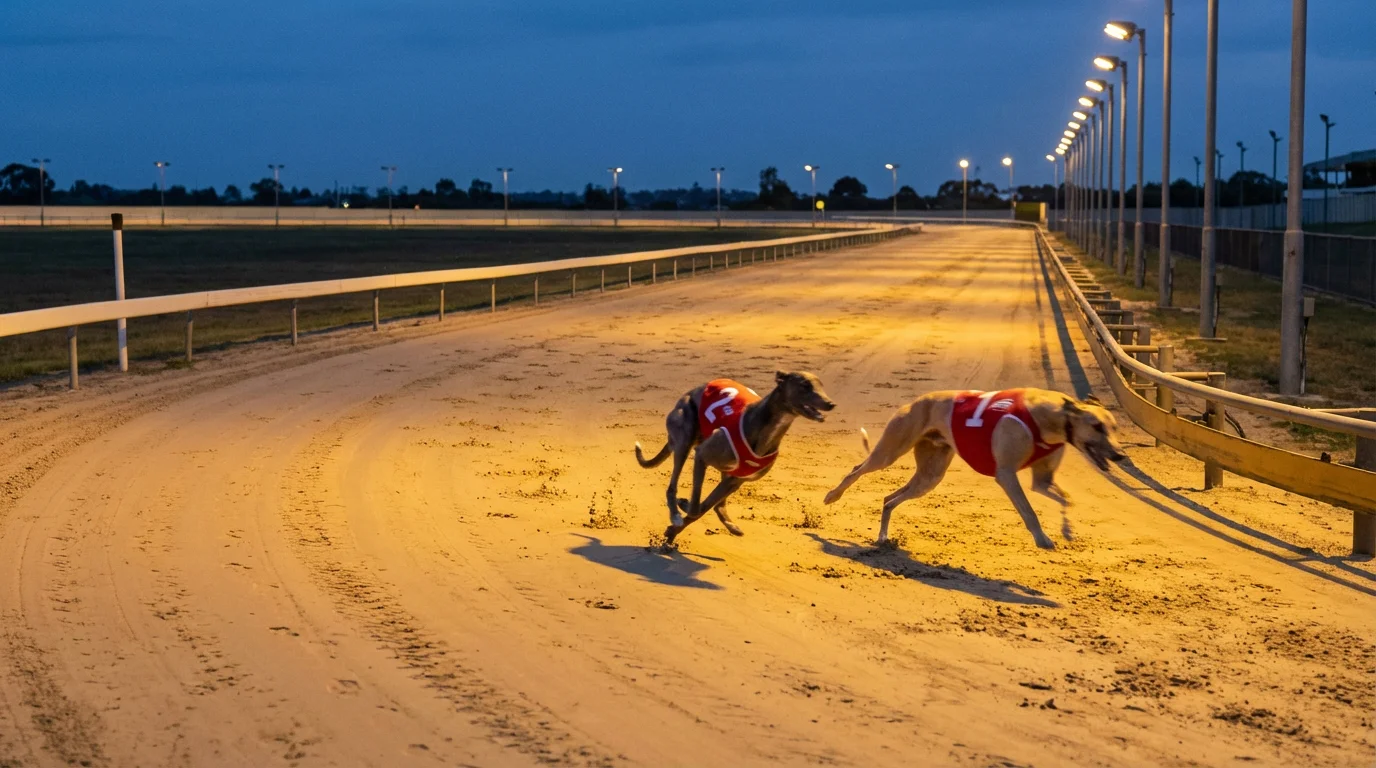
Distance Is the First Filter
Before you study the form, before you check the trap draw, before you glance at the odds — look at the distance. Every greyhound race in the UK is run over a specific measured trip, and that trip determines which physical and tactical attributes matter most. A dog built for explosive acceleration over 260 metres is a different animal from one bred to sustain pace over 680. They might both be fast, but fast at what? The distance answers that question, and it should shape every assessment that follows.
UK greyhound tracks offer races across a range of distances, typically from around 260 metres up to 900 metres or beyond at a handful of venues. These distances are not standardised across tracks — a “480” at one track differs from a “480” at another because track circumference, bend radius, and run-up distance vary. But the broad categories are consistent across the sport: sprints, standard trips, middle distances, and staying races. Each category produces a distinct type of race with its own tactical dynamics, form patterns, and betting implications.
Understanding distance is not optional for serious bettors. It is the foundational variable that everything else sits on. A dog’s form at 480 metres tells you almost nothing about how it will perform at 680. Conversely, a dog with mediocre sprint form that suddenly appears in a staying race might be about to show you something entirely different. Distance changes the question you are trying to answer.
Find more race guides at greyhoundresultstoday.
Sprint, Standard, Middle, and Staying Distances
Sprint races in UK greyhound racing are typically run over distances between 260 and 300 metres, covering two bends. These are the purest tests of trap speed and acceleration. The race is over in roughly sixteen seconds, and there is almost no time to recover from a slow start or first-bend trouble. The dog that breaks fastest and reaches the first bend in front wins the majority of sprint races — not because the others are slow, but because two bends do not provide enough track for a closer to make up lost ground. Trap draw is disproportionately important in sprints: inside traps with a short run to the rail typically hold a statistical advantage at most tracks.
The standard distance at most UK tracks is 480 metres, covering four bends. This is the bread and butter of greyhound racing — the distance at which the largest number of races are run and the distance around which the grading system is primarily built. At 480 metres, the race lasts roughly 29 to 30 seconds and demands a blend of early pace, bend technique, and finishing effort. Unlike sprints, there is enough race to allow some tactical variation: a dog that breaks slowly can recover through the middle portion of the race and challenge in the final straight. Front-runners still hold an advantage, but it is less decisive than in sprints.
Middle distances occupy the range between roughly 550 and 640 metres, usually covering five or six bends. These trips begin to favour dogs with sustained pace over pure acceleration. The tactical picture shifts noticeably: the importance of the trap break diminishes because there are more bends and more straight to compensate for a poor start. Dogs that are rated as steady-pace types on the standard trip sometimes show their best form when stepped up to middle distances, where their ability to maintain rhythm rather than burn out from a fast start becomes an asset.
Staying races cover 680 metres and above, with some tracks offering trips of 840 or even 900 metres. These are the marathons of greyhound racing, lasting well over 40 seconds and testing stamina, durability, and racing intelligence in ways that shorter distances simply do not. Staying races produce a higher proportion of results where the winner came from behind, because there are enough bends and enough straight for closers to work through the field. The form patterns are distinct: a dog that finishes strongly over 680 metres is showing a physical attribute — aerobic endurance — that cannot be faked or replicated at shorter trips. Stayers tend to be more consistent than sprinters because their primary attribute, stamina, is less susceptible to the randomness of trap breaks and first-bend interference.
Hurdle races have historically featured at a small number of UK tracks, though they were always relatively uncommon. Following the closure of Crayford in January 2025 — the last track to regularly feature hurdles — the future of hurdle racing in UK greyhound racing is uncertain. Hurdle distances are typically longer, and the addition of obstacles introduces a further variable — jumping ability — that is not tested at any flat distance.
How Distance Shapes Running Style
A dog’s running style and distance preference are inseparable. The sprinter and the stayer are not simply running different lengths of the same race — they are running fundamentally different types of race, and the physical demands select for different body types, temperaments, and biomechanical profiles.
Sprinters tend to be compact, muscular dogs with explosive acceleration from the traps. Their racing style is front-loaded: maximum effort in the first few seconds to establish position, then sustained speed through two bends. If they do not lead or sit close to the lead by the first bend, their race is effectively over because the distance does not allow recovery. Sprinters typically show consistent trap speeds across their form — the first sectional time barely varies between runs. What changes is whether they get a clean run through the two bends or encounter interference that nullifies their early pace advantage.
Standard-distance dogs need a broader skill set. They must break competently, handle four bends without losing excessive ground, and still have enough finish to hold their position or close on the leaders in the final straight. The best 480-metre dogs combine early pace with the ability to sustain it — they lead or sit close to the lead, and they do not fade in the final hundred metres. Dogs that lack early pace but finish strongly are often described as “not quite fast enough for 480, not quite strong enough for 680” — a liminal zone that produces inconsistent results.
Middle-distance and staying specialists are typically leaner, with a longer stride and a more economical running action. They sacrifice explosive acceleration for aerobic efficiency, which means they are often slow to establish position but relentless once they settle into their rhythm. In form terms, stayers frequently show moderate or poor early positional figures — they might be fourth or fifth at the first bend — but their finishing positions improve consistently as the race lengthens. Reading staying form requires patience: you are looking for late gains and closing sectionals rather than early speed figures.
Distance preference is not always obvious from a dog’s early career. Young greyhounds are often trialled at the standard distance, and some that appear moderate over 480 metres reveal genuine ability when stepped up. Trainers who recognise a dog’s stamina characteristics early can target the right distances from the start, but others take several races to find the optimal trip. For bettors, the signal to watch for is a dog that has been racing competitively at 480 metres but consistently finishes its races strongly — coded “RanOn” or “StydOn” — without quite winning. That dog, moved to 550 or 680 metres, may be about to improve sharply.
Distance and Betting — What Changes
The betting dynamics shift meaningfully across distance categories. Sprint markets tend to be dominated by the trap draw — the inside traps produce a statistically higher win rate at sprint distances at most tracks, and the betting market reflects this. Favourites in sprint races have a higher strike rate than favourites in staying races, because the reduced race distance limits the number of variables that can intervene. For bettors, sprints are harder to find value in because the market is more efficient: there is less information to interpret and less tactical complexity to exploit.
Standard-distance races offer the widest range of betting opportunities. The four-bend format introduces enough variables — trap draw, early pace, bend running, finishing speed — that the market regularly misprices runners. This is where most of the form-analysis tools discussed across greyhound betting literature apply most directly: sectional times, trouble codes, running-line analysis, and trap statistics all have their greatest predictive power over the standard trip.
Staying races present a different value landscape. The market is often less efficient because fewer bettors study staying form in depth, and the events attract less public money. Dogs tend to be more consistent over longer distances, but the longer race also means more bends and more opportunity for interference, which introduces a controlled element of unpredictability. Forecast and tricast bets can be particularly rewarding in staying races because the form tends to narrow the field to three or four genuine contenders, but the order in which they finish depends on the specific pace scenario of the race — which varies from day to day.
The Right Dog at the Right Trip
Every distance demands different qualities, and the dogs that win consistently are the ones running at the trip that suits their physical profile. The mistake many casual bettors make is treating all greyhound races as interchangeable — backing the dog with the best recent form regardless of whether that form came at a comparable distance. A dog with three recent wins over 280 metres is not necessarily a good bet at 480. Its entire form profile — trap speed, bend handling, finishing effort — was built at a distance that tests a different set of attributes.
When you see a dog stepping up or dropping in distance, treat it as a partially new proposition. Some of the existing form transfers and some does not. Ask what the distance change demands: does the dog have the stamina to handle a longer trip? Does it have the speed to compete at a shorter one? Look for corroborating evidence in the form — late finishing efforts that suggest untapped stamina, or early-pace figures that suggest speed being wasted at too long a trip.
Also explore our UK tracks.
Distance is the first filter, and it should be the last sanity check. Before you commit to a selection, ask whether this dog, at this distance, on this track, is running the race it was built to run. If the answer is no, the rest of the analysis is decorating a weak foundation. If the answer is yes, you are starting from solid ground — and everything else you layer on top has a better chance of being right.
