

Real Dogs, Fake Races
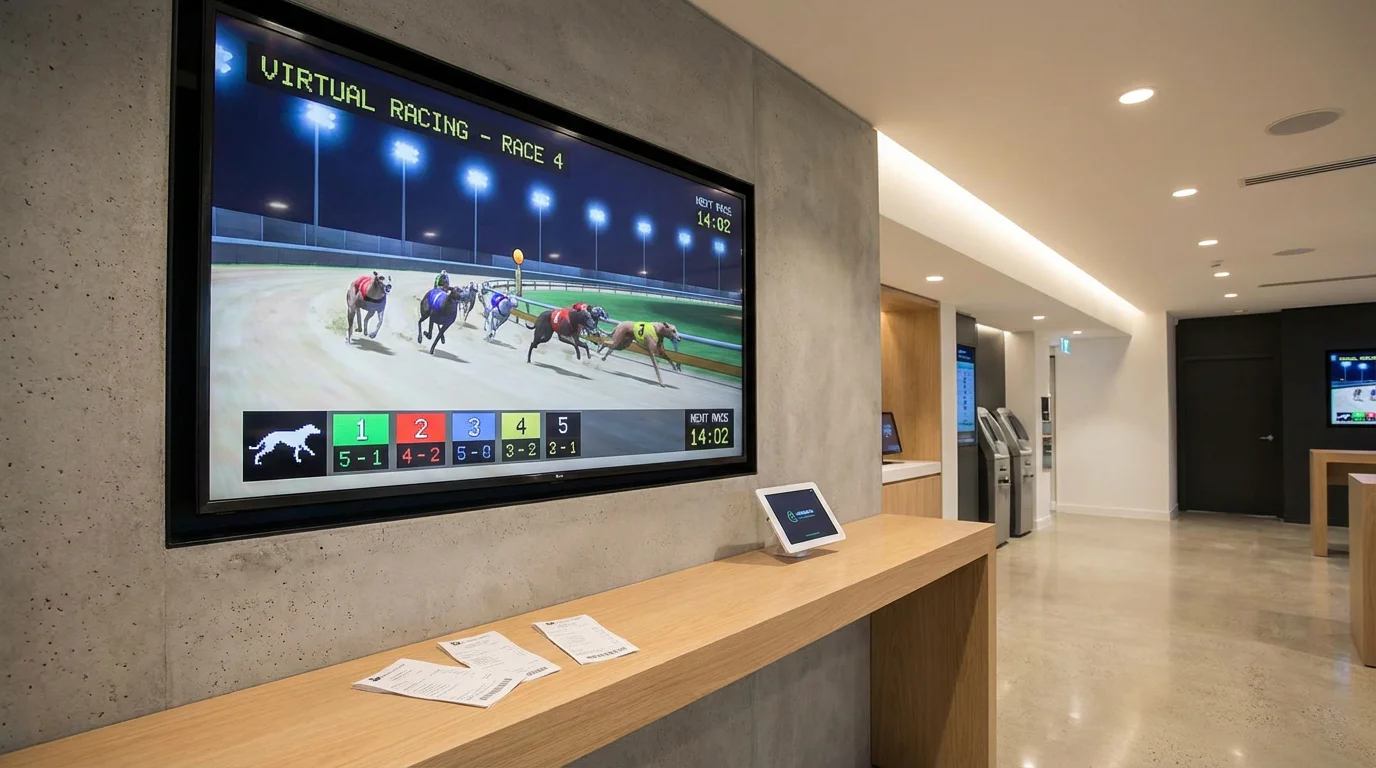
Virtual greyhound racing looks like the real thing — animated dogs break from traps, round bends, and sprint down a finishing straight while a commentator calls the action. The graphics have improved dramatically over the past decade, and on a quick glance through a betting shop window or a mobile screen, you could mistake a virtual race for a low-resolution stream of the real sport. But virtual greyhound racing is not greyhound racing. It is a computer programme generating predetermined outcomes dressed in sporting visuals. Understanding what it is — and what it is not — matters, because the betting dynamics are entirely different from real racing.
Virtual races are available around the clock through most UK bookmakers, typically running every two to four minutes. There is no off-season, no cancelled meeting due to weather, no waiting for the evening card. This constant availability is the product’s primary appeal and, for some bettors, its primary risk. The absence of downtime removes the natural pauses that exist in real greyhound betting — the gaps between races, the gaps between meetings — and replaces them with an unbroken stream of opportunities to bet.
This guide explains how virtual greyhound races are generated, what determines the odds, and the fundamental differences between virtual and real greyhound betting that every punter should understand before placing a stake.
Find more racing guides at greyhoundresultstoday.
How Virtual Races Are Generated
Virtual greyhound races are produced by software providers — companies like Inspired Entertainment, Kiron Interactive, and others that license their products to bookmakers. The software generates each race through a random number generator that determines the finishing order before the animated race begins. The animation you watch is a visual representation of an already-decided outcome, not a simulation of dogs actually racing against each other in real time. The result exists before the traps open on your screen.
The RNG at the heart of every virtual race is certified and regularly audited by gambling regulators. In the UK, the Gambling Commission (gamblingcommission.gov.uk) requires that virtual sports products meet specific standards of randomness and fairness. The outcomes must be genuinely random within the parameters of the product’s design, and the RNG must be independently tested to confirm that no patterns or exploitable sequences exist. This regulatory oversight means the virtual product is not rigged in the colloquial sense — the outcomes are random and the house edge is fixed and transparent.
Each virtual dog in a race is assigned a set of characteristics — speed, stamina, trap speed, and sometimes a running style — that influence its probability of finishing in each position. These characteristics are not based on a real dog’s form. They are numerical values assigned by the software that determine each runner’s win probability for that specific race. The dog labelled “Trap 1” in one virtual race has no connection to the dog labelled “Trap 1” in the next. There is no form, no history, and no trajectory. Each race is an isolated event with an isolated set of probabilities.
The animation is cosmetic. The virtual dogs do not race according to physics — they follow a scripted sequence that matches the predetermined finishing order. If the RNG determined that Trap 3 wins by two lengths from Trap 5, the animation renders that specific finish. The apparent “style” of the race — a dog appearing to make a late run, another fading in the straight — is visual storytelling wrapped around a mathematical outcome. No amount of watching virtual races will reveal patterns, because the outcomes are generated independently and the animations are designed to look like racing, not to be racing.
Odds and RNG Mechanics
The odds in a virtual greyhound race are set by the software provider based on the assigned probabilities for each runner. If Trap 2 has been assigned a 25 percent win probability for a particular race, its odds will be approximately 3/1 (after the built-in margin is applied). Unlike real greyhound racing, where the odds reflect the collective opinion of the betting market, virtual odds are fixed by the algorithm and do not move in response to money placed by punters. You cannot shorten a virtual favourite by backing it, and the price you see is the price you get.
The house edge on virtual greyhound racing is significantly higher than on real racing. A typical bookmaker overround on a real six-dog greyhound race is 15 to 20 percent. On virtual greyhound races, the effective margin is often 25 to 40 percent or higher, depending on the software provider and the bookmaker’s configuration. This means a smaller proportion of the total money staked is returned to bettors. In real greyhound racing, approximately 80 to 85 pence of every pound staked is returned to punters over time. In virtual racing, the figure may be 60 to 75 pence. The difference is substantial and compounding — over a hundred bets at the same stake, virtual racing costs you significantly more in expected losses than real racing.
Forecast and tricast markets on virtual races carry even wider margins. The combination of higher base overrounds and the multiplication of probabilities across multiple selection positions means the expected return on virtual forecasts is poor relative to the equivalent real-racing product. If you find forecast betting appealing in virtual greyhounds, understand that the house edge on those markets is among the highest in any UK betting product.
One common misconception is that virtual races follow patterns. Because the RNG determines outcomes independently, there is no streak, no trap bias, no hot favourite, and no meaningful form. A trap that wins three virtual races in a row is not “due” to lose, and a trap that has not won in twenty races is not “due” to win. Each race is mathematically independent of every other. Any pattern you think you detect is either random noise or a cognitive bias — your brain imposing structure on genuinely structureless data.
Virtual vs Real — Key Differences
The most important difference is the one that matters for bettors: real greyhound racing has a skill element, and virtual racing does not. In real racing, studying form, assessing trap draws, reading sectional times, and analysing trouble-in-running codes gives you information that the market may not have fully priced in. That informational edge is the foundation of profitable betting. In virtual racing, no such edge exists. The outcomes are random, the characteristics change every race, and no analytical approach can produce an expected return above the house edge over time.
The second difference is pace. Real greyhound meetings run on a schedule — races at a track are typically spaced ten to fifteen minutes apart, and meetings happen at specific times of day. Virtual races run every few minutes, all day, every day. This relentless pace encourages frequent, impulsive betting because there is always another race starting. The natural pauses that real racing provides — time to assess the next card, review results, make a cup of tea — do not exist in the virtual world. Bettors who struggle with impulse control are more vulnerable to virtual racing than to real racing simply because the product never stops offering opportunities to bet.
The third difference is emotional engagement. Real greyhound racing involves living animals with genuine histories, trainers with reputations, and tracks with identities. The outcome matters beyond the bet: you are watching something real, and the experience of winning or losing is tied to a tangible event. Virtual racing is animation. The dogs are pixels. The satisfaction of winning is purely financial, and the experience of losing can feel particularly hollow because you know the outcome was an algorithm rather than an athletic competition. For some bettors, this detachment makes virtual racing easier to walk away from. For others, it makes the product feel low-stakes in a way that encourages higher and more frequent bets.
The House Always Runs in Virtual Racing
Virtual greyhound racing is a fixed-margin gambling product, not a betting market. In real greyhound racing, you are competing against other bettors and the bookmaker’s margin, with the possibility of finding an edge through superior analysis. In virtual racing, you are competing against a mathematical certainty: the house edge guarantees that the product generates profit for the operator over any significant sample size. No strategy, no selection method, and no staking plan can overcome this. The question is not whether you will lose over time — it is how fast.
This does not make virtual greyhound racing inherently bad. As entertainment — a few quick bets during a lunch break, a low-stakes diversion when no real racing is on — it can serve a purpose. The graphics are reasonable, the races are short, and the constant availability fills a gap that real racing cannot. But it must be treated as entertainment with a known cost, not as an opportunity to apply betting skill. Any money allocated to virtual greyhound racing should come from an entertainment budget, not from a serious betting bankroll. The two should never mix.
Also read our greyhound live streaming.
If you enjoy greyhound betting because of the form analysis, the strategic challenge, and the satisfaction of being right about a dog’s chance, virtual racing has nothing to offer you. The skill that makes real greyhound betting rewarding is irrelevant in the virtual version. Stick with the real dogs. They are harder to predict, slower to pay out, and infinitely more interesting — and they are the only version where what you know actually matters.
