

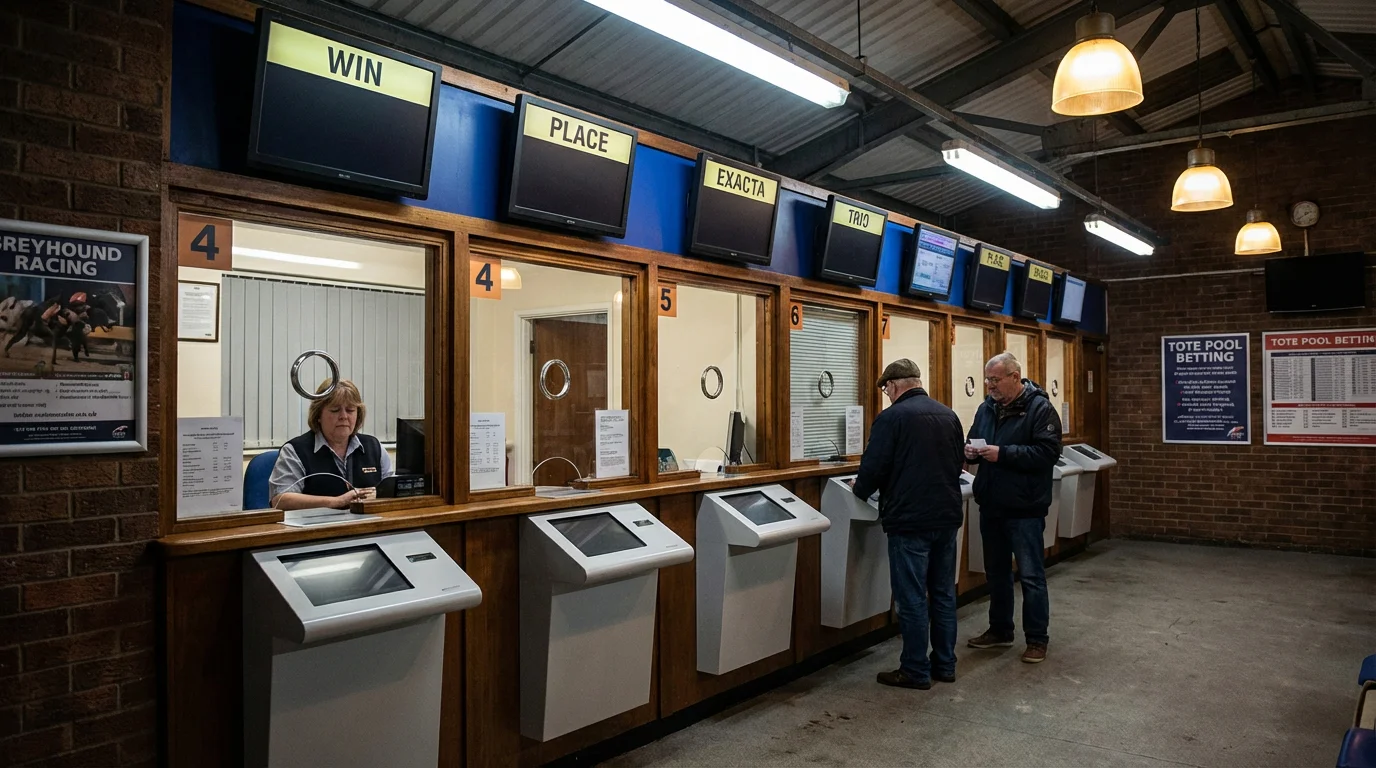
Betting Against the Crowd, Not the Bookmaker
Most greyhound bets in the UK are placed at fixed odds — you take a price, the dog wins or loses, and the payout is determined by the number on your slip. Pool betting works on an entirely different principle. Instead of a fixed return, your stake goes into a shared pool with every other punter who bet on the same market. After the race, the total pool is divided among the winning tickets, minus a deduction for the operator. Your payout depends not on a price set before the race but on how many other people picked the same result. If you backed the winner and few others did, the dividend is large. If half the pool backed the same dog, the dividend is modest.
Pool betting on greyhounds has a long history in the UK, tied to the Tote — originally the Horserace Totalisator Board, now part of the wider UK betting infrastructure. The Tote operates pool betting alongside bookmaker fixed-odds markets at tracks and through online platforms, offering a parallel pricing mechanism that sometimes returns more than fixed odds and sometimes less. For the punter who understands when pool betting has an edge over fixed odds, it provides a genuine alternative rather than a curiosity.
This guide covers how pool betting works mechanically, the main Tote bet types available on greyhounds, and the specific circumstances where pool bets beat the fixed-odds alternative.
Find more bet type guides at greyhoundresultstoday.
How Pool Betting Works
The mechanics of pool betting are straightforward. All stakes on a given bet type for a given race are collected into a single pool. The operator takes a fixed percentage — the takeout or deduction — which funds prize money, operating costs, and profit. The remainder is the net pool, which is distributed among winning ticket holders in proportion to their stakes. If the net pool is one thousand pounds and you hold a ten-pound winning ticket out of a hundred pounds’ worth of winning tickets, you receive one hundred pounds — a return of 10/1 on your stake.
The critical difference from fixed-odds betting is that you do not know your potential return when you place the bet. The dividend is only determined after the pool closes and the race result is confirmed. You know your stake; you do not know the price. This uncertainty is the fundamental trade-off of pool betting: you give up the certainty of a fixed return in exchange for a dividend that may be higher or lower than the bookmaker price, depending on how the rest of the pool behaved.
The takeout percentage varies by bet type and operator but is typically in the range of 15 to 30 percent. On a simple win pool, the takeout is usually at the lower end — around 15 to 20 percent. On more exotic pools like the jackpot or combination bets, the takeout tends to be higher because the operator’s administrative and prize-fund costs are greater. This deduction is the pool’s equivalent of the bookmaker’s overround, and it means that pool betting, like fixed-odds betting, has a built-in house edge. The question is not whether the house takes a cut — it always does — but whether the pool’s dividend on your winning bet exceeds what the bookmaker would have paid.
Pool size matters enormously. Large pools — those with significant total stakes — produce dividends that closely reflect the actual probability of outcomes, because the weight of money irons out individual quirks. Small pools are volatile: a single large stake on an unpopular selection can dramatically distort the dividend. Greyhound pools tend to be smaller than horse racing pools because the sport attracts less pool-betting volume, which means greyhound pool dividends are more variable and occasionally more generous than their horse racing equivalents.
One structural advantage of pool betting is that the market cannot be manipulated by a single bookmaker decision. In fixed-odds markets, the bookmaker sets the price and can shade it to manage liability. In a pool, the dividend is determined by the collective behaviour of all punters. If the crowd overlooks a genuine contender, the pool price on that dog will be generous — not because a bookmaker decided to offer a long price, but because insufficient money was placed on that outcome relative to its probability. This crowd-sourced pricing mechanism occasionally produces dividends that no individual bookmaker would ever have offered.
Tote Bet Types: Jackpot, Placepot, Exacta
The win pool is the simplest Tote bet: pick the winner. Your stake enters the win pool for that race, and if your dog wins, you share the net pool with all other winning ticket holders. The win pool dividend is the closest pool equivalent to a fixed-odds win bet, and you can directly compare the two after each race to see which paid more. In practice, the win pool dividend on greyhounds is sometimes higher than SP and sometimes lower, with no consistent pattern — making it a viable alternative rather than a reliable upgrade.
The place pool works the same way but for placed finishes — typically first and second in a six-dog greyhound race. Your stake is pooled with all other place bets on that race, and the net pool is shared among those who backed a placed dog. Place pool dividends on greyhounds tend to be modest because first and second in a six-dog race cover a third of the field, producing a high proportion of winning tickets. The place pool is less attractive as a standalone bet but becomes relevant as part of each way pool wagering, where your stake is split between the win and place pools.
The exacta — sometimes called the forecast pool — requires you to pick the first two finishers in the correct order. This is the pool equivalent of a straight forecast. The exacta pool produces higher dividends than the win pool because the bet is harder to land, concentrating the net pool among fewer winning tickets. On greyhound racing, exacta pools can return dividends that significantly exceed the computer forecast dividend offered by bookmakers, particularly when the result is an upset or when the first two home are not the obvious market principals. This is where pool betting most often beats fixed odds on greyhounds.
The trifecta — the pool equivalent of a tricast — requires the first three in correct order. The dividends can be substantial, but greyhound trifecta pools are often small, which makes the dividends volatile and occasionally disappointing even when the result looks like it should have paid well. A small pool with a popular combination can produce a trifecta dividend barely better than the bookmaker tricast.
Jackpot and placepot bets are multi-race pools that require you to find the winner (jackpot) or a placed finisher (placepot) in every race on a designated card. These are the most challenging pool bets and the most rewarding when they land. Jackpot pools on greyhound meetings accumulate across races, and if no punter selects all winners, the pool rolls over to the next qualifying meeting — creating occasionally large accumulated pools that attract attention and volume. Placepots are more achievable because placing (first or second) is easier than winning, but the dividends are correspondingly smaller.
When Pool Bets Beat Fixed Odds
Pool betting beats fixed odds in specific, identifiable situations. The first is when the winner is unpopular with the pool-betting crowd. If the pool has been concentrated on two or three fancied runners and the winner is a less-backed dog, the dividend is generous because the net pool is divided among fewer winning tickets. In fixed-odds terms, this is equivalent to backing a winner at a longer starting price — but the pool dividend can exceed even the SP because the pool crowd backed the winner less heavily than the fixed-odds market priced it.
The second situation is exotic bets with upset results. Exacta and trifecta pools pay their best dividends when the finishing order is unexpected. A result where the second favourite beats the favourite in an exacta may pay a bookmaker forecast of fifteen pounds to a one-pound stake. The pool exacta on the same result might return twenty or twenty-five pounds because the pool crowd overwhelmingly backed the favourite to finish first, leaving more of the net pool for those who had the correct combination.
The third situation is small pools with contrarian picks. When the total pool is small — common on afternoon greyhound meetings — individual stakes have a larger proportional impact. If you are the only person in a small win pool backing the eventual winner, your dividend will be the entire net pool divided by your stake. These scenarios are unpredictable and infrequent, but they produce occasional windfalls that fixed-odds betting cannot replicate.
Conversely, pool betting underperforms fixed odds when the winner is the obvious favourite. If most of the pool backed the winner, the dividend is diluted and typically returns less than the fixed-odds SP. For short-priced favourites in greyhound racing, fixed odds are almost always the better option because the pool dividend on a popular winner rarely matches the bookmaker price.
The Poolside View — Crowds Set the Dividend
Pool betting inverts the punter’s relationship with the market. In fixed-odds betting, you are competing against the bookmaker’s assessment. In pool betting, you are competing against the collective opinion of every other punter in the pool. When the crowd is wrong — when it over-backs one dog and under-backs another — the pool dividend on the under-backed winner is generous. When the crowd is right, the dividend is thin.
This means pool betting rewards contrarian thinking. The punter who identifies a genuine contender that the crowd has overlooked stands to earn a larger return from the pool than from fixed odds, because the pool’s dividend reflects the crowd’s error. The punter who backs the popular pick receives a dividend that reflects the crowd’s consensus, which is usually less than the fixed-odds price on the same outcome.
Also see our bet types.
For most greyhound bettors, pool betting should be a complement to fixed-odds betting, not a replacement. Use fixed odds when you are backing popular selections or when certainty of return matters. Use pool bets — particularly exactas — when you have identified an unpopular combination that the crowd is likely to underweight. The two pricing mechanisms coexist for every race, and the punter who checks both and takes whichever pays better is extracting more value than one who defaults to either in isolation.
