

A Hundred Years Around the Bend
Greyhound racing in Britain is almost exactly a century old, and in that time it has been a working-class obsession, a national pastime rivalling football in attendance, a political target, a cultural punchline, and — through all of it — a sport that refused to disappear. The story of the dogs in the UK is a story about class, commerce, regulation, and the stubborn persistence of a spectacle that millions of people loved even when the establishment wished they would not.
Understanding the history of greyhound racing is not just an exercise in nostalgia. The sport’s past explains its present: why tracks are where they are, why the grading system works as it does, why the betting market has its particular structure, and why the relationship between the sport and the gambling industry has been both symbiotic and contentious for a hundred years. The greyhound punter who knows the history has a richer understanding of the sport than one who sees it only through tonight’s racecard.
Learn more about the sport at greyhoundresultstoday.
Origins: Belle Vue 1926 and the Early Boom
Modern greyhound racing in Britain traces its origins to a single evening in Manchester. On 24 July 1926, Belle Vue stadium hosted what is generally regarded as the first organised greyhound meeting on a circular track with an artificial hare in the UK (SIS Racing). The concept had been imported from the United States, where oval-track racing with a mechanical lure had been developed in the early 1920s. A promoter named Charles Munn, along with Major Lyne-Dixson, brought the idea across the Atlantic, and Belle Vue was the venue they chose to prove the concept (GBGB).
The first meeting was a sensation. Crowds packed the stadium, and the sight of greyhounds chasing a mechanical hare around an oval track at high speed proved immediately and powerfully popular. Within months, new tracks were opening across the country. By the end of 1927, more than forty stadiums were operating in England alone. By the early 1930s, the number had risen past seventy. The speed of the expansion reflected a genuine public appetite — greyhound racing offered something that no other sport at the time provided: affordable evening entertainment in urban areas, with the added excitement of legal on-course betting.
The social context matters. Britain in the late 1920s was a country of industrial cities with large working-class populations that had limited entertainment options. Football was a Saturday afternoon affair. The cinema was popular but passive. The pub was ever-present but repetitive. Greyhound racing offered something new: a social evening out, with action every fifteen minutes, food and drink available on site, and the thrill of a bet. Tracks were deliberately built in or near working-class neighbourhoods, accessible by public transport, and priced to attract regular attendance. The sport was, from its first day, designed for the people who built and staffed the factories and docks that powered the economy.
The betting element was central. On-course Tote betting was legal from the outset, and the pools grew rapidly as attendance climbed. The Tote’s monopoly on legal on-track betting gave greyhound stadiums a financial model that combined admission revenue, catering, and gambling income — a structure that sustained the sport through its first decades and set the template for the commercial relationship between racing and wagering that persists today.
By the late 1930s, annual attendance at licensed UK greyhound tracks had reached well over 32 million — a staggering figure that made it one of the best-attended sports in the country. The sport had established a network of major stadiums, a rudimentary grading system, and a calendar of feature events that gave the racing season a narrative structure. The English Greyhound Derby, first run in 1927 at White City (Towcester Racecourse), became the sport’s premier event and remains so a century later.
Golden Era and Decline
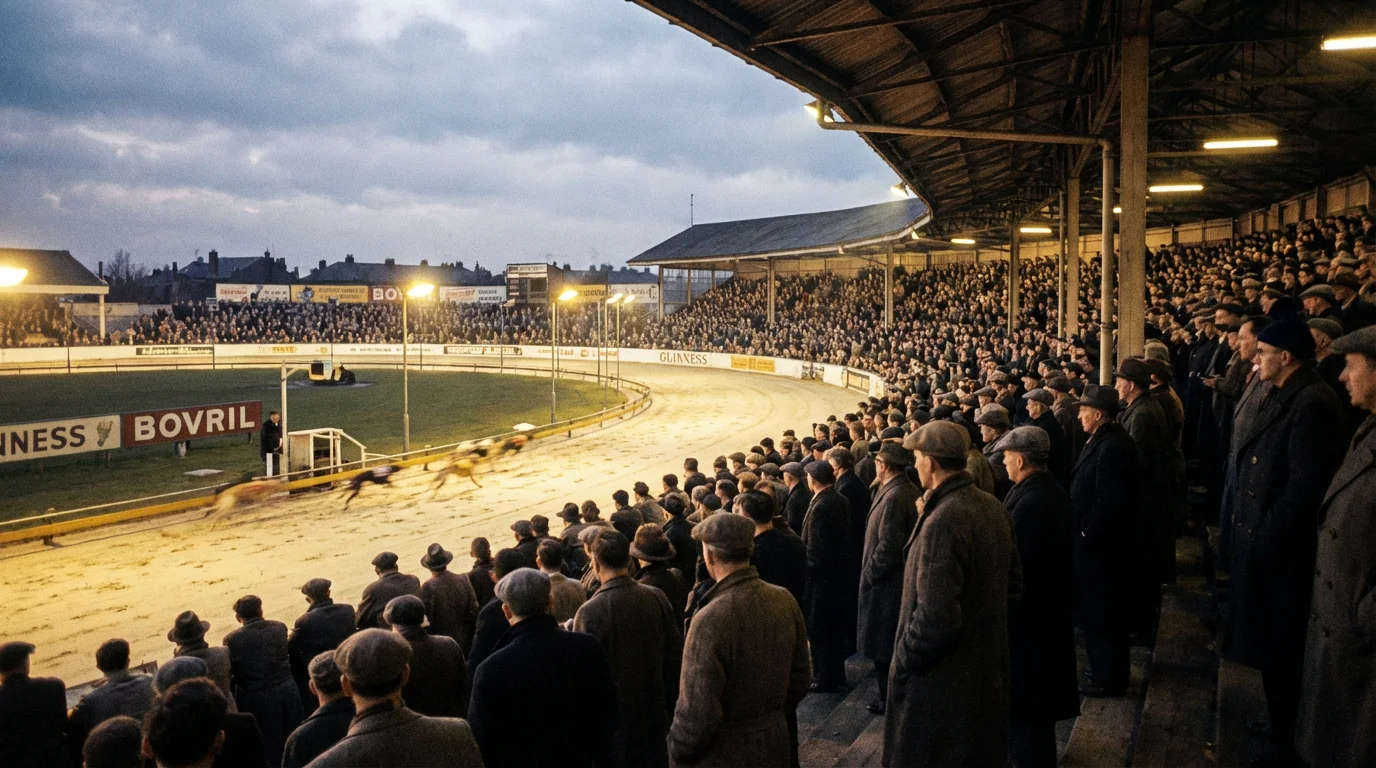
The post-war period from the late 1940s through the 1960s is often described as the golden era of British greyhound racing. Attendance peaked in 1946 at over 34 million — a figure that reflected both the sport’s genuine popularity and the limited competing entertainment available in post-war austerity Britain. Stadiums operated multiple meetings per week, often drawing crowds of ten thousand or more for a routine evening card. The top dogs were genuine celebrities: Mick the Miller, who won consecutive Derbies in 1929 and 1930 and later appeared in a feature film (GBGB), had established the template for the greyhound racing star, and subsequent champions maintained public interest through newspaper coverage and newsreel features.
The betting industry around greyhound racing matured during this period. On-course bookmakers operated alongside the Tote at tracks, and a substantial off-course illegal betting market existed in factories, pubs, and on street corners. The legalisation of off-course betting shops in 1961 — through the Betting and Gaming Act 1960 (legislation.gov.uk) — transformed the economics of greyhound betting by moving much of this money into regulated channels. Betting shops displayed greyhound results alongside horse racing, and the sport gained a permanent presence in the daily betting routine of millions of British punters.
The decline began in the 1970s and accelerated through the 1980s and 1990s. Multiple factors converged. Television offered an expanding menu of evening entertainment that competed directly with the social function of the greyhound track. Car ownership allowed leisure time to be spent further from home, reducing the captive urban audience. Property values in the inner-city locations where many tracks sat rose dramatically, creating powerful economic incentives for developers to buy and redevelop stadium sites. Tracks closed at an alarming rate: from over sixty licensed stadiums in the 1960s, the number fell to around thirty by the turn of the millennium.
Each closure erased not just a venue but a community. Greyhound racing had always been hyperlocal — punters supported their neighbourhood track with the same loyalty they gave their football club. When Wimbledon closed, when Catford closed, when Walthamstow closed in 2008 in one of the most publicly mourned closures of the era, the loss was felt by the regulars who had attended for decades. The sport was contracting geographically even as it retained a committed core following.
The welfare debate added a further dimension. From the 1990s onward, animal welfare organisations raised increasingly vocal concerns about the treatment of racing greyhounds — rehoming rates for retired dogs, injury incidence on track, and the fate of dogs that could not be rehomed. These concerns generated negative press coverage and political pressure that the sport’s governing bodies were slow to address comprehensively. The welfare issue did not cause the decline, but it damaged the sport’s public image at a time when it could least afford reputational harm.
Modern Revival and GBGB Regulation
The Greyhound Board of Great Britain, established as the sport’s regulatory body, has overseen a gradual modernisation of UK greyhound racing since the early 2000s. The GBGB licenses tracks, regulates racing rules, oversees welfare standards, and administers the grading and results systems that bettors rely on. Its role is roughly analogous to the British Horseracing Authority in horse racing — a governing body that sits between the sport and the betting industry, managing integrity, welfare, and competition standards.
Welfare improvements have been significant. The GBGB introduced a comprehensive injury reporting system, mandated veterinary presence at all licensed meetings, and invested in rehoming programmes for retired racing greyhounds. The Greyhound Trust and other rehoming organisations work alongside the GBGB to ensure that retired dogs find homes, and the rehoming rate has improved substantially over the past two decades. These changes have not silenced all criticism, but they represent a genuine and measurable commitment to welfare that the sport lacked in earlier decades.
The betting landscape has transformed the sport’s economics. Online betting now accounts for the vast majority of greyhound wagering, and the revenue that tracks receive from betting — through media rights, picture rights, and levy-style payments — has become more important than gate receipts. The SIS broadcast network delivers live pictures from UK tracks to bookmaker platforms, and the availability of live streaming has made greyhound betting accessible to punters who have never visited a track in person. This shift has simultaneously widened the sport’s betting audience and weakened the live-attendance model that sustained tracks for their first eighty years.
The current track landscape in the UK is stable at around eighteen GBGB-licensed venues (GBGB), supplemented by a number of independent tracks operating outside the GBGB framework. The licensed circuit includes venues ranging from major stadiums with regular evening meetings and feature events to smaller operations that run less frequent cards. The sport is smaller than it was at its peak by every measure — fewer tracks, lower attendance, less media coverage — but it retains a dedicated following and a betting market that generates substantial turnover.
A Sport That Refuses to Stop Running
A century is a long time for any sport, and greyhound racing has spent much of that century being told it was dying. The closures of the 1980s and 1990s were supposed to be terminal. The welfare controversies of the 2000s were supposed to be the final blow. The migration of betting online was supposed to make the live product irrelevant. At each stage, the predictions of the sport’s demise have been premature — not because the challenges were imaginary, but because the core appeal of greyhound racing is remarkably durable.
Six dogs, one trap, thirty seconds. The spectacle is elemental: speed, competition, and uncertainty compressed into the shortest race format in British sport. The betting market around it is deep enough to reward skill and volatile enough to reward attention. The sport has adapted — imperfectly, sometimes belatedly — to welfare standards, regulatory requirements, and technological change. It is not the cultural force it was in 1946, and it may never be again. But it is present, it is active, and the dogs are still running.
Also read our greyhound racing distances.
For the modern greyhound punter, the history is not just background. It explains why the tracks are configured as they are, why the grading system works the way it does, why the betting market has its specific relationship with live racing, and why the sport continues to generate the kind of form data and competitive racing that makes skilled betting possible. A hundred years of trial, error, and persistence produced the sport you are betting on tonight. That is worth knowing.
