

- Odds Are Prices, Not Prophecies
- Fractional, Decimal, and American Odds
- Starting Price — How It's Set and What It Means
- Betfair Starting Price (BSP)
- Implied Probability and Overround
- Rule 4 Deductions — The Withdrawal Tax
- Finding Value — When the Price Is Wrong
- Best Odds Guaranteed on Greyhounds
- Price Memory — Why Yesterday's Odds Still Matter
Odds Are Prices, Not Prophecies
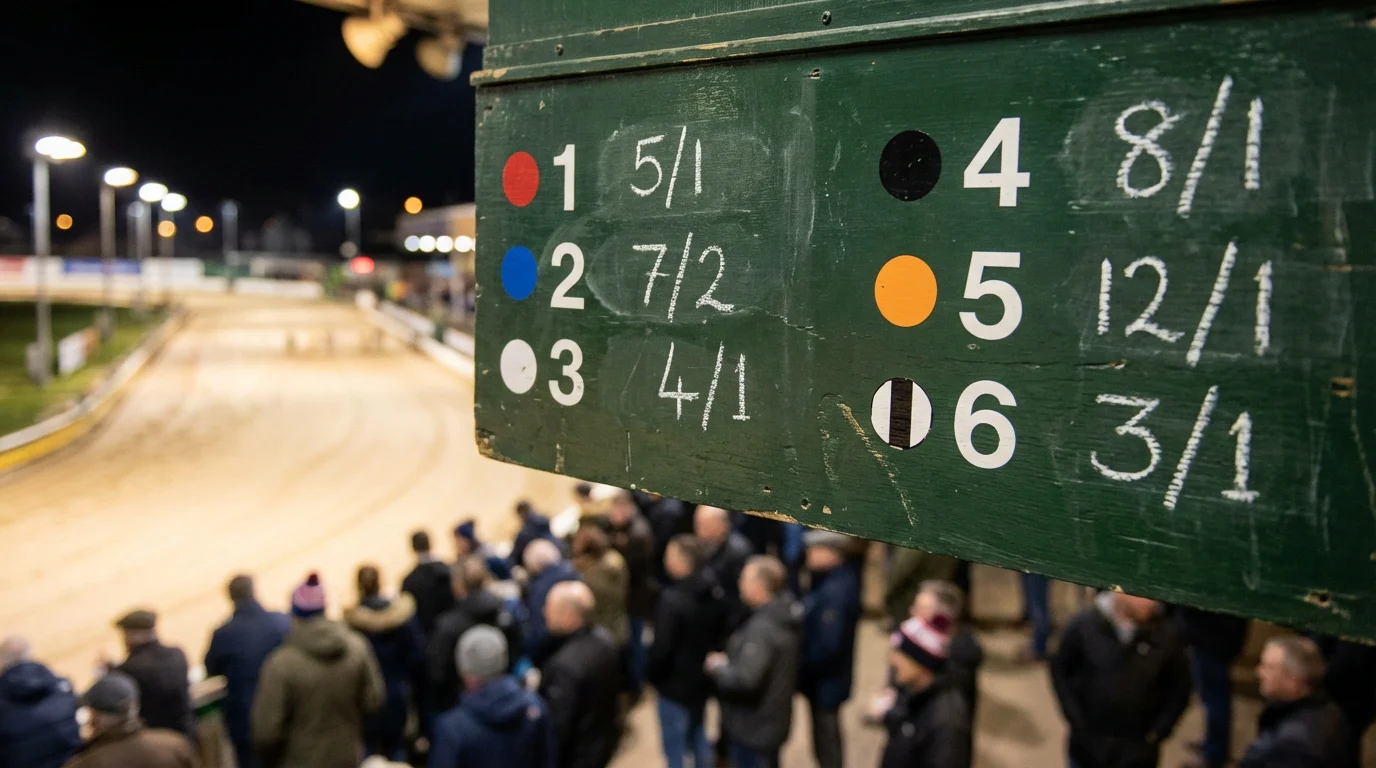
A 3/1 shot doesn’t win one race in four — that’s just what the bookmaker thinks. Or more precisely, it’s what the bookmaker wants you to pay for that outcome. This distinction is fundamental to understanding greyhound racing odds, and it’s the concept that underpins everything else in this guide. Odds are not mathematical truths about a dog’s chance of winning. They’re prices set by a market — shaped by supply, demand, bookmaker margins, and the collective opinion of everyone who puts money down.
Once you internalise this, the way you look at a racecard changes. You stop asking “will this dog win?” and start asking “is this dog’s chance of winning better than these odds suggest?” The first question has a yes-or-no answer that you can’t know in advance. The second is a comparison you can make with analysis, and it’s the foundation of every profitable betting approach.
This guide covers the mechanics of greyhound odds from the ground up: how the different odds formats work, how starting prices are determined, what Betfair’s BSP offers that traditional bookmaker odds don’t, how implied probability and overround affect your bottom line, and where to look for the pricing errors that create value. Whether you’re new to greyhound betting or experienced enough to know most of this already, the details matter — and the details are where the edges hide.
Find more odds guides at greyhoundresultstoday.
Fractional, Decimal, and American Odds
UK greyhound betting defaults to fractional odds — but knowing all three formats makes you fluent in any market. The three systems express the same underlying reality in different ways, and once you understand the conversion, you can move between bookmakers, exchanges, and international platforms without missing a beat.
Fractional odds are the traditional UK format. A dog at 5/1 (read “five to one”) returns five pounds of profit for every one pound staked, plus your stake back. At 7/2, you receive three pounds fifty for every pound staked. The fraction literally expresses the ratio of profit to stake. Fractional odds are intuitive for UK punters raised on them, but they can be awkward for quick calculations — comparing 11/4 against 13/5 in your head isn’t instant.
Decimal odds represent the total return per unit staked, including the stake itself. The 5/1 fractional price becomes 6.00 in decimal. The 7/2 becomes 4.50. The advantage of decimal odds is that comparison is immediate: 6.00 is obviously bigger than 4.50 in a way that 5/1 versus 7/2 isn’t at a glance. Decimal odds are the standard on European platforms and on betting exchanges like Betfair, so even if you think in fractions, you’ll encounter decimals regularly.
American odds use positive and negative numbers relative to a 100-unit baseline. A +500 line is the equivalent of 5/1 or 6.00 — you’d win 500 units on a 100-unit stake. A -200 line means you need to stake 200 units to win 100, which translates to 1/2 or 1.50 decimal. American odds are rare in UK greyhound betting but appear on international platforms, so recognising the format is useful even if you never use it as your primary display.
The conversion between formats is mechanical. To go from fractional to decimal, divide the fraction and add one: 5/1 equals 5.0 plus 1, giving 6.0. To go from decimal to fractional, subtract one and express as a fraction: 4.50 minus 1 equals 3.50, which is 7/2. To convert to implied probability — the most useful transformation for analytical purposes — divide one by the decimal odds: 1 divided by 6.0 equals 0.167, or 16.7%. This tells you what the odds “say” about the dog’s chance of winning, which you can then compare against your own assessment.
Starting Price — How It’s Set and What It Means
The starting price is the last word on what the market thought before the traps opened. It’s the official odds returned on a dog at the moment the race begins, and it’s the price at which most bets are settled if you take SP rather than a fixed early price. Understanding how the starting price forms — and why it sometimes differs from the price you saw when you placed your bet — is essential for anyone betting on greyhounds regularly.
In greyhound racing, the SP is derived from the on-course betting market and the prices offered by bookmakers at the time of the off. Unlike horse racing, where an independent SP reporter observes the on-course boards, greyhound starting prices are typically generated through a combination of market activity and bookmaker pricing models. The process is less visible to the punter than the horse racing equivalent, but the principle is the same: the SP represents the final market consensus on each dog’s chance.
How the On-Course Market Forms the SP
At a greyhound meeting, on-course bookmakers set their tissue — their initial assessment of the field — based on form, grading, and other available information. As money comes in from punters both on-course and off-course, the prices adjust. A dog attracting heavy betting support will see its odds shorten, while a dog being ignored will drift to longer prices. The starting price captures this adjusted market at the point the race begins.
Off-course betting flows also influence the SP, particularly in the modern era where the vast majority of greyhound wagers are placed online or in betting shops rather than at the track. Bookmakers’ liability management systems react to the volume and pattern of bets across their entire customer base, and these reactions feed back into the prices that contribute to the SP calculation. The result is that the starting price reflects a broad market view — not just what a handful of on-course punters are doing.
SP vs Early Prices — When to Take and When to Wait
The tactical question for bettors is whether to lock in an early price or take SP. The answer depends on the situation. If you believe a dog is underpriced in the early market — perhaps it’s at 5/1 now but you expect it to shorten to 3/1 as more punters spot its form — taking the early price secures the better value. If you think the early price is too short and the market will drift, waiting for SP or placing a late bet could yield better odds.
In practice, most sharp greyhound punters prefer to take an early price when they believe they’ve identified value, rather than relying on SP. The reason is simple: if your analysis is good and you’ve spotted something the market hasn’t yet fully reflected, the early price is the one that contains the most value. By the time the SP forms, the market has had more time to correct, and the inefficiency you identified may have been priced out. Best Odds Guaranteed — where offered on greyhounds — eliminates the downside of taking an early price, since you’ll receive whichever is higher: your locked-in price or the SP.
Betfair Starting Price (BSP)
BSP strips out the bookmaker’s margin and returns the exchange market’s assessment. The Betfair Starting Price is an algorithmically calculated price based on the unmatched bets and limit orders in the Betfair exchange at the time a race starts. It’s not the same as the traditional SP, and the differences matter for serious punters.
The key advantage of BSP is that it reflects genuine supply and demand without the bookmaker’s overround built in. When a traditional bookmaker prices a six-dog race, the combined implied probabilities will add up to well over 100% — the excess being the house edge. The BSP, because it’s derived from exchange activity where individual bettors set the prices, tends to be closer to a true 100% market, minus Betfair’s commission on winning bets (typically 2% to 5% depending on your activity level).
In practical terms, BSP often returns higher prices than traditional bookmaker SP on mid-range and longer-priced runners. A dog that returns 5/1 SP with the traditional bookmakers might come back at 5.8 or 6.2 in BSP on Betfair. Over hundreds of bets, that difference compounds significantly. On shorter-priced dogs, the difference is smaller and sometimes BSP is actually marginally lower than bookmaker SP, but across a balanced portfolio of selections, BSP tends to deliver better average returns.
The limitation is liquidity. Greyhound exchange markets are thinner than horse racing markets, which means BSP prices can be more volatile and less predictable than their horse racing equivalents. On a popular evening meeting at a major track, the exchange liquidity is generally adequate. On a midweek BAGS card at a smaller venue, the pool of exchange bettors may be small enough that a single large bet can skew the BSP significantly. If you’re using BSP as your settlement method, be aware that the price you receive is a function of exchange activity on that specific race, not a fixed market rate.
Implied Probability and Overround
Every set of odds contains a built-in house edge — your job is to figure out where it’s thinnest. Implied probability is the mechanism that makes the invisible visible. Convert every dog’s odds to a percentage, add them up, and the total tells you exactly how much the bookmaker is charging you to play.
The conversion is straightforward. A dog at 3/1 (4.00 decimal) has an implied probability of 25% — one divided by four. A dog at evens (2.00 decimal) implies 50%. A 6/1 shot implies 14.3%. In a perfectly fair market, the implied probabilities of all six runners would add up to 100%. In the real world, they add up to more — typically 115% to 125% for a UK greyhound race. That excess over 100% is the overround, and it represents the bookmaker’s built-in margin.
A 120% book means that for every hundred pounds wagered across all outcomes, the bookmaker expects to keep roughly twenty. Not on any individual bet, but across the entire market over time. The higher the overround, the harder it is for bettors to turn a profit. This is why comparing overrounds between bookmakers is a practical exercise: a bookmaker running a 115% book on greyhounds is offering structurally better value than one running at 125%, even if the individual prices on specific dogs look similar.
The overround isn’t distributed evenly across the field. Bookmakers tend to shave the most margin from the favourites — because that’s where the heaviest betting volume falls and competitive pricing matters most — and load extra margin onto the outsiders. This is known as the favourite-longshot bias, and it means that short-priced dogs are often closer to their true probability than long-priced dogs. For bettors, this creates an interesting dynamic: value on favourites is harder to find because the pricing is sharper, but the outsiders carry inflated margins, which means they need to be genuinely mispriced for a value bet to exist. The middle ground — dogs in the 3/1 to 7/1 range — is often where the margin distribution is most uneven and where systematic analysis can find the best opportunities.
Rule 4 Deductions — The Withdrawal Tax
Rule 4 exists because a missing dog changes every other dog’s chance. When a greyhound is withdrawn from a race after the betting market has formed, the remaining runners become more likely to win — but the odds already taken by bettors were set on the assumption that six dogs were competing. Rule 4 deductions are the mechanism by which bookmakers adjust payouts to account for the reduced field.
The deduction is applied as a pence-in-the-pound reduction to your winnings, scaled to the odds of the withdrawn dog. If the non-runner was the favourite at short prices, the deduction is higher because its removal has a larger impact on the remaining dogs’ chances. If the withdrawn dog was a rank outsider, the deduction is smaller. The scale runs from 5p in the pound for a withdrawn dog priced at 10/1 to 14/1, up to 90p in the pound for very short-priced odds-on shots. At the extreme end, a withdrawn odds-on favourite results in most of your profit being deducted.
In greyhound racing, Rule 4 situations arise most commonly when a dog is withdrawn at the kennels after a veterinary inspection or when a reserve runner fails to appear. Because greyhound races have only six runners (or occasionally eight in special events), the removal of even one dog has a proportionally larger effect than a withdrawal from a twenty-runner horse race. Losing one dog from six is losing 16.7% of the field.
The practical advice is simple: be aware that Rule 4 can reduce your returns and factor it into your risk assessment. If you’ve backed a dog at a price that’s only just above your value threshold, a Rule 4 deduction could push the effective odds below that threshold and turn a value bet into a losing proposition on expectation. Some punters avoid betting on races where a withdrawal seems likely — for example, when a dog has a recent history of veterinary issues — but this level of caution borders on excessive for most recreational bettors. Knowing the mechanism is sufficient; obsessing over it is counterproductive.
Finding Value — When the Price Is Wrong
Value betting is not about picking winners — it’s about picking prices. This principle was covered in the strategy context elsewhere, but in the odds context it’s worth examining the specific mechanics of how value manifests in greyhound markets. A price is wrong when the implied probability embedded in the odds is lower than the dog’s actual probability of winning. The gap between those two numbers — what you think the chance is versus what the bookmaker is charging — is where profit lives.
Finding that gap requires two capabilities. The first is an honest, reasonably calibrated assessment of a dog’s winning chance, built from form analysis, track knowledge, trap statistics, and pace dynamics. The second is the discipline to compare your assessment against the market price and only bet when the gap is large enough to justify the risk. A dog you rate as a 25% chance at 3/1 (25% implied) is not a value bet — it’s fairly priced. The same dog at 7/2 (22.2% implied) starts to look interesting. At 4/1 (20% implied), you’re getting paid 25 cents on the dollar for a 25-cent chance — and that, over volume, is profitable.
The greyhound markets where value most frequently appears are mid-grade races at familiar tracks, where the fields are competitive and the market’s attention is spread thinly. Open races and high-profile events tend to be priced more efficiently because they attract sharper money and more scrutiny. Lower-grade meetings on BAGS cards, by contrast, often have wider margins and less analytical coverage, creating more room for a prepared punter to find prices that don’t reflect the true picture.
One practical tool is maintaining a record of your pre-race probability estimates alongside the actual results. Over time, this builds a calibration dataset. If you consistently rate dogs as 25% chances and they win 30% of the time, your estimates are conservative — you’re finding more value than you thought. If they win 18% of the time, your estimates are optimistic, and you need to recalibrate. The record is what turns subjective opinion into measurable skill.
Best Odds Guaranteed on Greyhounds
BOG is free insurance — if a bookmaker offers it on greyhounds, take every qualifying race. Best Odds Guaranteed means that if you take an early fixed price on a dog and the starting price turns out to be higher, the bookmaker pays you at the better odds. If the SP is lower than your early price, you keep your locked-in price. Either way, you get the best of both worlds.
Not all bookmakers offer BOG on greyhound racing. It’s far less universal than in horse racing, where BOG is now a standard competitive feature. Some bookmakers restrict BOG to selected meetings, certain race types, or specific promotional periods. Others exclude greyhounds from the offer entirely. Before placing a bet at a fixed early price, check whether BOG applies. If it does, there’s no reason to take SP — lock in the early price and let BOG protect you against any drift.
The mathematical impact of BOG is small on any individual bet but material over a long series. If you place three hundred bets a year and BOG upgrades your odds on fifty of them by an average of half a point, that’s twenty-five extra points of profit you wouldn’t have received without the guarantee. In a game where margins are thin and long-term profitability depends on accumulating small edges, BOG is one of the easiest advantages to capture because it requires no additional analysis — just checking a box in the right places.
Price Memory — Why Yesterday’s Odds Still Matter
The market has a memory, and punters who track price patterns start to see things the casual bettor misses. A dog’s opening odds and how those odds move before a race tell you a story about market sentiment that has predictive value beyond the price itself. A dog that opens at 5/1 and drifts to 8/1 is being abandoned by informed money. A dog that opens at 5/1 and shortens to 3/1 is attracting support. Neither movement guarantees the outcome, but both contain information that the final price alone doesn’t reveal.
Tracking price movements across consecutive races builds a longer-term picture. A dog that has been steadily shortening in the market over its last three outings — from 8/1 to 5/1 to 7/2 — is a dog the market respects increasingly. If its form figures support that trend, the convergence of market sentiment and performance data is a strong signal. Conversely, a dog whose prices have been drifting despite decent form figures may be telling you something the racecard can’t: perhaps the in-the-know money has noticed a physical issue, a change in the dog’s behaviour, or a track switch that doesn’t suit.
Historical price data is available through platforms like Oddschecker and Betfair’s own records. Building your own price-tracking spreadsheet for dogs at your specialist track adds a layer of analysis that most punters don’t bother with. It takes five minutes per meeting to note opening and closing prices for each runner. Over a month, you have a dataset that reveals which dogs the market consistently underprices and which it consistently gets right — and that dataset becomes a tool for identifying value before the market has fully adjusted.
Also read our greyhound starting prices.
Odds in greyhound racing are not fixed truths. They’re moving, breathing expressions of collective opinion, shaped by money, information, and sometimes misinformation. The punter who reads the odds as a static number is getting half the picture. The punter who reads the movement — where the price came from, where it’s going, and what that trajectory implies — is getting closer to the full story. In a sport where thirty seconds separates the opening of the traps from the finish line, the hours of price movement beforehand carry more information than most people realise.
