

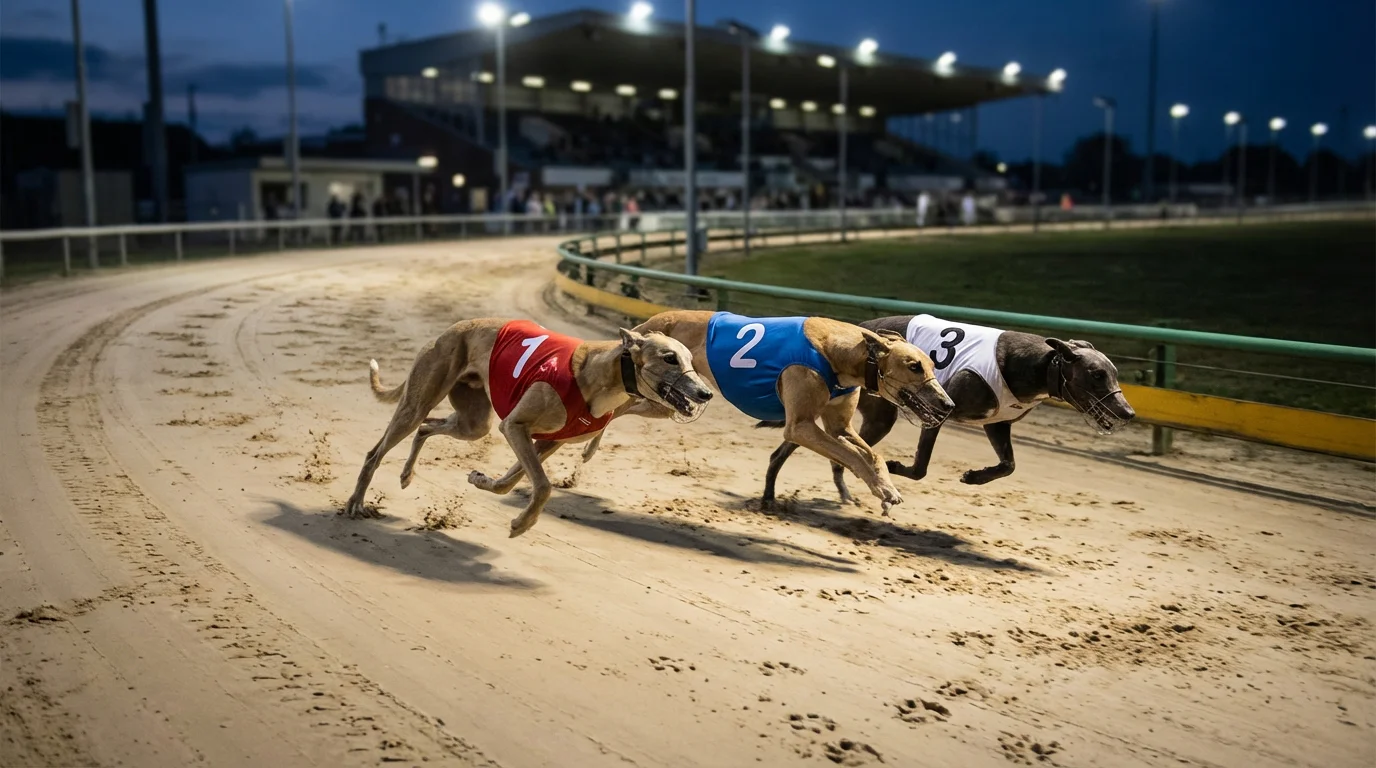
Three in a Row — The Tricast Challenge
Tricasts pay big because they’re hard — very hard. You need to name the first three dogs to finish a race, and in a standard six-runner UK greyhound event, the number of possible finishing combinations for the top three is 120. A straight tricast — where you must predict the exact order — gives you a 1 in 120 chance in a perfectly even field. Even with form, trap data, and track knowledge narrowing the probabilities, you’re still betting into a market where the hit rate is naturally low.
That difficulty is the entire appeal. Computer tricast (CT) dividends in greyhound racing regularly return £50 to £500 or more for a £1 stake. On occasions where longer-priced dogs fill the minor places, returns of £1,000+ from a single £1 bet are not unheard of. For punters who enjoy the analytical challenge of predicting race shape at a deeper level than simply picking a winner, the tricast offers a bet type where a handful of successful calls per month can outweigh a long string of losses.
But the maths must be respected. The same volatility that produces spectacular returns also produces extended losing runs, and punters who approach tricasts without a clear staking discipline and a genuine understanding of cost structures tend to bleed money quietly over time.
Find more bet type guides at greyhoundresultstoday.
Straight Tricast vs Combination Tricast
Straight demands exact order; combination gives you breathing room at a price. The two tricast variants available in UK greyhound racing differ fundamentally in how much precision they require, and the cost difference between them is steep.
A straight tricast (STC) is the simplest form. You name dog A to finish first, dog B to finish second, and dog C to finish third. One bet, one unit stake. If all three land in exactly the order you specified, you collect the CT dividend. Any deviation — even if all three dogs fill the top three but in a different sequence — results in a losing bet. The discipline required is substantial. You’re not just assessing who the best three dogs are; you’re predicting which one has the raw speed to lead, which one finishes best from midfield, and which one holds on for third.
A combination tricast (CTC) removes the ordering constraint. You select three or more dogs, and the bet covers every possible arrangement of your selections in the first three places. For three dogs, that’s six permutations (A-B-C, A-C-B, B-A-C, B-C-A, C-A-B, C-B-A), so the bet costs six times your unit stake. If any arrangement of your three dogs fills the top three spots, you win. The payout is the CT dividend for the actual finishing order — one of the six combinations — so the return is fixed regardless of which permutation lands.
Adding a fourth dog to a CTC increases the permutations to 24. A fifth dog produces 60 permutations. The formula is n × (n − 1) × (n − 2), where n is the number of selections. At four dogs from a six-runner field, you’re covering 24 of the 120 possible outcomes — a 20% probability in a perfectly even field. That sounds almost manageable, but at £1 per permutation, you’re spending £24 to chase a dividend that might be £40 if the favoured dogs dominate, or £300 if a longer-priced inclusion fills one of the places.
The choice between straight and combination depends on your conviction and the race you’re targeting. In races where you have a strong view on the winner and the second — perhaps a clear front-runner and a strong closing dog — the straight tricast lets you express that opinion cheaply. The third-place pick is often the hardest part, and if you’re guessing on that slot, a combination tricast on three dogs allows you to hedge the order without the expense of adding more selections.
What Tricasts Actually Cost
A four-dog combination tricast is 24 bets — do the maths before the traps open. The staking table for CTCs is one of those things every tricast punter should know by heart, because the numbers escalate far faster than intuition suggests.
| Selections | Permutations | Cost at £1 | Cost at £0.50 |
|---|---|---|---|
| 3 dogs | 6 | £6 | £3 |
| 4 dogs | 24 | £24 | £12 |
| 5 dogs | 60 | £60 | £30 |
| 6 dogs (full perm) | 120 | £120 | £60 |
The 5-dog CTC at £60 covers every possible top-three arrangement from five of the six runners. You’re only excluding one dog. At that point, you’re essentially betting that one specific greyhound won’t finish in the top three — which makes it functionally closer to a lay bet on a single runner than a traditional tricast selection. The cost is rarely justified unless you have a very strong view that one dog is genuinely incapable of placing.
The sweet spot for most tricast punters is the three-dog CTC at £1 per line (£6 total) or the four-dog CTC at £0.50 per line (£12 total). These keep the outlay manageable while providing enough coverage to absorb the inherent uncertainty in predicting three places. The key discipline is resisting the temptation to add a fifth or sixth dog “just in case” — every addition multiplies your cost without proportionally improving the probable dividend.
Straight tricasts, by contrast, cost a single unit stake and offer the purest risk-to-reward ratio. If you’re confident in all three positions, the STC gives you the highest possible profit margin on a successful bet. The trade-off is that you’ll be wrong far more often.
Selecting for Tricasts — Race Shape Matters
Tricast winners come from reading the race, not just picking the three best dogs. The distinction is critical. Form ratings might tell you that dogs A, B, and C are the three most talented runners in a race, but greyhound racing doesn’t work like a ranking exercise. The trap draw, the early pace, the bend position, and the hare rail all intervene between raw ability and finishing order.
Start with the front of the race. Which dog will lead through the first bend? This question is often answerable with reasonable confidence based on trap position and early pace data. A dog with consistently fast sectional times from an inside draw is a natural leader at most UK tracks. That dog becomes your anchor — the foundation of any tricast construction.
Then consider what happens behind the leader. Dogs drawn in traps 3 and 4 at many tracks get squeezed at the first bend as the inside and outside runners converge. A dog with strong late pace but a central draw may find trouble early and recover to finish third, not second. Conversely, a wide runner from trap 6 who avoids first-bend interference often runs into second place even when they lack the raw speed to win.
The best tricast races share common traits: a clear front-runner, at least one strong finisher with a favourable draw, and a field where the remaining runners are either too slow or too likely to encounter trouble to threaten the top three. Races where five of the six dogs have a realistic chance of placing are poor tricast opportunities — the variance is too high and the dividend too unpredictable to justify the stake.
Pay attention to race grades as well. Lower-graded races (A6 and below) tend to produce more chaotic results because the dogs are less consistent. Higher-graded and open races often feature more predictable pace patterns and form lines, making them better tricast targets. The dividends may be smaller when the market is tight, but the hit rate improves enough to compensate.
Patience and the Long Tricast Game
Tricast punters need to think in weeks and months, not individual races. The nature of the bet — low probability, high reward — means that losing runs are long and winning spells are concentrated. A punter who lands one tricast in fifteen attempts at an average CTC cost of £6 has spent £90 to get there. The dividend needs to exceed that figure to show a profit, and it won’t every time.
The mental discipline is harder than the selection process. After seven, eight, nine consecutive losing tricasts, the instinct is to increase stakes, add more dogs to combinations, or abandon the approach altogether. All three reactions are counterproductive. Increasing stakes amplifies losses during the drought without improving the probability. Adding dogs inflates costs. Quitting means you absorb the losing run without being present for the eventual winning dividend.
The professional approach is flat staking at a fixed percentage of your tricast bankroll — a separate pot from your main betting bank. If you allocate £200 per month to tricasts and your average bet costs £6, you have roughly 33 attempts. At a realistic hit rate of one in ten to one in fifteen, you should land two to three winners per month. Whether those dividends exceed the £200 outlay depends entirely on the quality of your selections and the prices in your chosen races.
Keep detailed records. Note not just whether the tricast landed, but whether your selected dogs finished in the top three at all. If your three picks are consistently filling the frame but in the wrong order, straight tricasts are costing you — switch to combinations. If your selections aren’t making the top three at all, the issue is selection, not bet structure, and no amount of combination coverage will fix it.
Also read our greyhound forecast bet.
Tricasts are not for every punter and not for every race. They suit patient, analytical bettors who enjoy the process of race-reading and accept the low-frequency, high-variance nature of the returns. Approached with discipline and realistic expectations, they offer one of the most intellectually rewarding ways to engage with greyhound racing. Approached with impatience, they offer one of the fastest ways to empty a betting account.
