

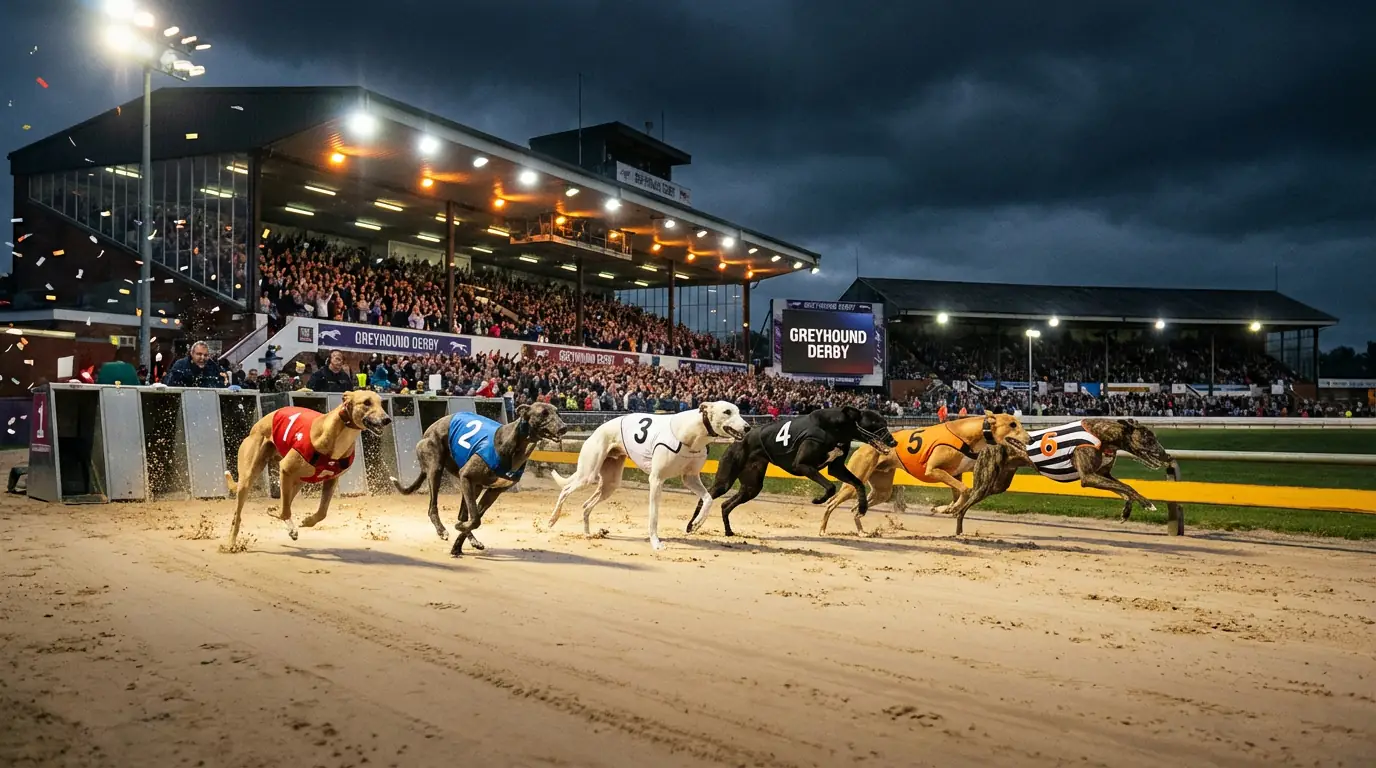
The Race That Defines the Sport
The English Greyhound Derby is the most prestigious event in UK greyhound racing — the equivalent of the Epsom Derby in flat horse racing or the FA Cup final in football. It is the race every trainer targets, every owner dreams of winning, and every serious greyhound punter circles on the calendar months in advance. The Derby generates the deepest betting markets in the sport, attracts the largest ante post interest, and produces a final night atmosphere that no regular meeting can match.
But the Derby is not a single race. It is a tournament — a multi-round knockout competition that stretches across several weeks of heats, quarter-finals, and semi-finals before six dogs line up for the final. Betting on the Derby therefore demands a different approach from betting on a regular graded race. You are not assessing a single field on a single evening. You are evaluating dogs across multiple rounds, accounting for accumulated fatigue, trap draw variations, and the tactical decisions that trainers make as the competition progresses. The punter who approaches the Derby as just another race will bet on it as just another race. The punter who approaches it as a campaign will find edges that the flat-market bettor misses.
This guide covers the Derby’s format and structure, how to approach ante post betting through the heats and semi-finals, and what to look for when the final night arrives.
Find more race guides at greyhoundresultstoday.
Derby Format and Tournament Structure
The English Greyhound Derby follows a knockout format that filters a large entry field down to six finalists. The exact number of initial entrants varies by year, but the process is consistent: dogs are drawn into heats of six runners, and the top finishers from each heat — typically the first two or three — progress to the next round. Quarter-finals follow the same pattern, with qualifiers advancing to the semi-finals and then to the six-dog final.
The competition is currently held at Towcester (GBGB), a track that demands specific attributes from its contenders. Towcester’s circuit features wide, sweeping bends and a long run-in to the finish, which favours dogs with sustained pace and strong finishing speed over pure trap-speed specialists. A dog that dominates at a tight track like Romford through explosive early pace may not translate that form to Towcester, where the extra width through the bends rewards galloping dogs with an efficient racing line. This venue-specific factor is central to Derby assessment: the winner needs to handle Towcester specifically, not just be the fastest dog in the country at any track.
The multi-round format introduces physical demands that a single-race assessment does not account for. A Derby finalist will have raced three or four times over the preceding weeks, all at competition intensity against top-class fields. The physical toll of these rounds — cumulative fatigue, the risk of minor injuries, the stress of repeated travel to the venue — is a real factor by the semi-final and final stages. Dogs that arrive at the final fresh and injury-free have a tangible advantage over those that have had hard races, even if their raw ability is comparable. Durability is as important as speed in a tournament format.
Trap draws are assigned for each round, and a dog’s draw changes from heat to heat. A dog that drew trap one in its heat may draw trap six in the quarter-final. This randomisation means that Derby contenders must be versatile — capable of performing from any draw position rather than dependent on a specific trap. Dogs that have shown strong form from multiple traps during their pre-Derby campaign are more reliable Derby propositions than those whose best runs have all come from one favoured position.
The progression criteria — which dogs qualify from each round — are worth tracking closely. In some years, the fastest losers are also reprieved into the next round, which introduces an additional path to the final for dogs that encountered trouble in their heat but posted fast times. Understanding the qualification rules for the specific year’s competition helps you identify dogs that may survive an early setback rather than assuming that any heat loss is elimination.
Ante Post Approach to Heats and Semi-Finals
The ante post market for the Derby outright winner opens weeks before the first heats and offers the longest prices you will see on any contender. This is where the most significant value is available — and where the most significant risk lies, because ante post bets are settled as losers if the dog does not reach the final for any reason. The price compensates for this risk, but only if the ante post market has genuinely mispriced the dog’s chances.
The approach to ante post Derby betting should be staged rather than concentrated. Rather than placing a single large outright bet before the heats and hoping for the best, divide your Derby betting allocation across the stages of the tournament. An initial ante post position on a dog you have identified through pre-Derby form provides exposure at the longest price. As the heats progress and your selection survives, you can assess whether to add to your position, hedge on the exchange, or stand pat. This staged approach limits your exposure if the dog exits early and allows you to manage your position as new information emerges.
Heat assessment is the first genuine form test of the competition. Watch every heat — or, at minimum, study the race replays and sectional times. The information you are gathering is not just whether a dog won its heat but how it won. A dog that led from trap to line on the rail, unchallenged and comfortable, has had an easy passage and arrives at the next round fresh. A dog that won after being bumped at the first bend and fighting through from fourth has demonstrated resilience but may have expended more energy than the bare result suggests. The winner who was barely tested is often the better quarter-final bet than the winner who was fully extended.
Semi-final assessment follows the same logic but with heightened importance. By the semi-finals, the field has been filtered to its strongest contenders, and the quality gap between runners narrows. Trap draw becomes more significant because every dog in the semi-final has the ability to exploit a good draw. The pace map — which dogs will lead, which will sit mid-pack, which will close — is easier to project in the semi-finals because you have heat form from the same venue to work with. Look for dogs whose semi-final draw suits the running style they demonstrated in the heats.
Between rounds, monitor kennel reports and trial times. Trainers often trial their Derby contenders at Towcester in the days between rounds to maintain sharpness and assess fitness. A fast trial between rounds is a positive signal. A missed trial or a report of the dog looking below par is a warning sign that the campaign may be taking a physical toll. This between-round intelligence is where the attentive punter gains an advantage over the casual bettor who only looks at the race results.
Final Night Betting Strategy
The Derby final is a six-dog race like any other in terms of mechanics — but it is unlike any other in terms of market behaviour. The final attracts significantly more betting volume than a regular greyhound race, including money from casual punters who follow the event through media coverage rather than from a position of deep form knowledge. This influx of public money can distort the market, over-backing popular dogs with name recognition and under-backing less fashionable contenders whose form is equally strong.
The trap draw for the final is the single most scrutinised piece of information in the pre-final market. Every percentage point of trap bias at Towcester is dissected, every possible pace scenario mapped. The draw matters, but it matters less than the quality gap between finalists. If the best dog in the final draws the worst trap, it is still the best dog — it just has a structural disadvantage that may or may not be sufficient to cost it the race. Do not let trap draw override form assessment; let it adjust the margins of your probability estimate.
The pace map is your most powerful tool on final night. By the time six dogs are confirmed for the final, you have heat and semi-final form for every one of them at the same venue. You know which dogs break fast, which sit mid-pack, which close from behind. You know which dogs run on the rails and which run wide. You can project, with reasonable confidence, how the first bend will unfold and which dogs will be positioned where by the time the field enters the back straight. That projection is the basis for your betting — more reliable than raw times, more specific than trap statistics, and more current than any pre-Derby form.
Consider the exchange as your primary platform for final-night betting. The Betfair market for the Derby final is the deepest greyhound exchange market of the year, with matched amounts that dwarf any regular race. The liquidity supports larger bets, tighter spreads, and more efficient pricing than the bookmaker market. If you have an ante post position from earlier in the competition, the exchange allows you to trade that position — locking in profit by laying your selection if its price has shortened, or adding to your position if you believe the market is still wrong.
One Night, One Race, One Dog — But Months of Homework
The Derby final lasts about thirty seconds. The preparation that produces a winning bet on that final can take months. The punter who identified a live contender in the ante post market, tracked its progression through the heats, assessed its fitness between rounds, studied the final draw, and projected the pace scenario is betting with information that the casual final-night punter does not have. That information does not guarantee a winner — thirty seconds of greyhound racing guarantees nothing — but it shifts the probability in a direction that the price may not fully reflect.
The Derby rewards the same skills that profitable greyhound betting always rewards: form analysis, pace reading, track knowledge, price awareness, and the patience to wait for the right moment to act. It just applies those skills across a longer time horizon and a higher-profile stage. If your regular greyhound betting process is sound, the Derby is an opportunity to deploy it on the biggest platform the sport offers. If your process is not sound, the Derby is just a more expensive way to discover that.
Also read our greyhound ante-post betting.
The dogs that win the Derby are not always the fastest in the competition. They are the ones that handled the draw, navigated the bends, sustained their effort across multiple rounds, and arrived at the final with enough physical and tactical quality to win the race that mattered most. That description — preparation meeting opportunity — applies to the winning punter as much as to the winning dog.
