Best Greyhound Betting Sites – Bet on Greyhounds in 2026
Loading...
The Shorthand That Tells the Story
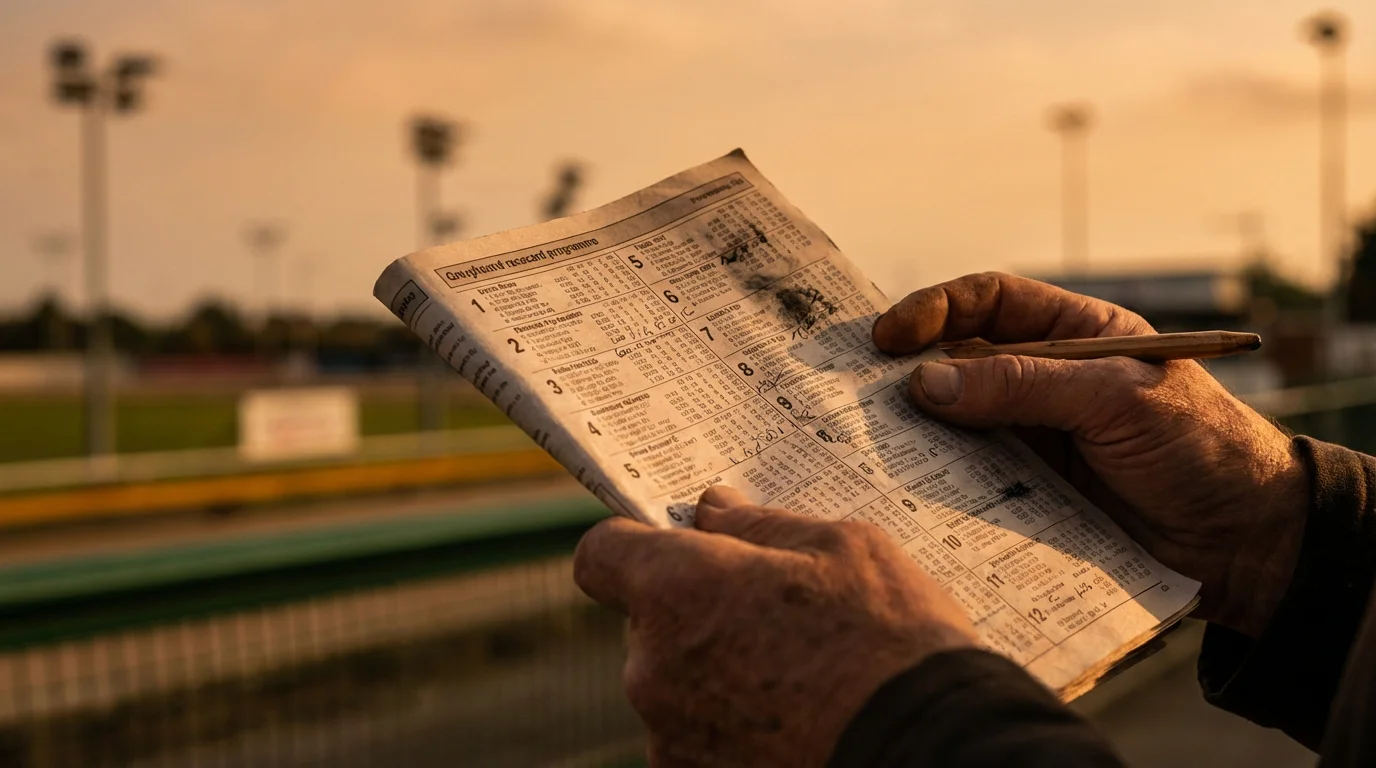
Greyhound form symbols are a compressed language — learn the alphabet and the stories write themselves. Every racecard you open is packed with letters, numbers, and abbreviations that look like someone dropped a keyboard down a flight of stairs. To the casual onlooker, a form line reading “1333 2111 6542” next to codes like Bmp1, Crd3, and RnUp is pure noise. To the educated punter, it is a detailed race-by-race biography of a running dog.
The industry settled on this shorthand decades ago for a practical reason: racecards are small, meetings are frequent, and nobody wants a paragraph of race commentary for each of six runners across twelve races on a Tuesday night. The symbol set compresses every meaningful event — where the dog ran at each stage, whether it encountered trouble, how it finished — into a line you can scan in seconds.
This guide unpacks the full symbol set used across GBGB-licensed tracks in the UK. Whether you are new to greyhound racecards or just find yourself guessing at certain codes, treat this as the reference sheet you always wanted. These symbols are standardised across all licensed UK tracks under the Greyhound Board of Great Britain framework. Independent or “flapping” tracks sometimes use their own systems, but anything on Timeform, the Racing Post greyhound pages, or the GBGB results feed follows the conventions described here.
Position and Running Codes
Every letter and number on a form line describes what happened at a specific point in the race. The core of any greyhound form entry is the position string — a sequence of digits that records where the dog sat at key stages. On a standard six-dog, 480-metre race at a four-bend track, you will typically see four or five positional readings: trap break, first bend, back straight or third bend, and finishing position. A form line of “3214” tells you the dog broke third, moved to second at the first bend, led going into the back straight, and finished fourth. That single string compresses a race lasting under thirty seconds.
The numbering runs 1 through 6, corresponding to first through sixth position. On longer distances (600m and above), you may see five or six positional readings because the race covers more bends. Sprint races (around 260m) usually show only two or three. When analysing form, note the number of digits — a five-position reading on a staying race gives far more tactical information than a two-position sprint form line.
Positional numbers are sometimes followed by letter codes describing running style. The most common: Led or L — held the lead. Disp or Dsp — disputing the lead. Mid or M — mid-division. W — running wide through bends. Rls — running on the rails. These modifiers matter because a dog leading on the rails through the first bend has a fundamentally different race profile from one sitting mid-pack and running wide.
The finishing position is sometimes accompanied by a distance marker expressed in lengths — roughly the body length of a greyhound, about 0.08 seconds at full gallop. “2 by 1½” means the dog finished second, one and a half lengths behind the winner. These distance indicators are critical: a dog finishing second by a neck had a vastly different race from one finishing second by six lengths.
You will also encounter these frequent position-related codes in race comments: EvPc — even pace, consistent position throughout. RnOn or RanOn — ran on late, finishing strongly. RnUp — ran up, closed ground on leaders without catching them. Fdd — faded, lost ground in the closing stages. Styd or StydOn — stayed on, keeping position under pressure rather than gaining dramatically.
These modifiers transform a bland finishing position into something predictive. A dog showing “RanOn” repeatedly at 480 metres may be worth following when it steps up to 600. A dog coded “Fdd” three times running might be physically declining or running at the wrong distance. The code is not the conclusion — it is the evidence from which you draw one.
Trouble-in-Running Symbols
The difference between “bumped first bend” and “checked third bend” is everything. Trouble-in-running codes explain why a result happened rather than just what happened. A dog that finished fifth having been bumped at the first bend and forced wide through the second is an entirely different prospect from a dog that finished fifth in a clear run. One had bad luck; the other might just be slow.
Bmp — bumped, the most frequent trouble code, always followed by a number indicating where the incident occurred: Bmp1, Bmp2, and so on. Severity varies enormously. A glancing bump at the third bend when trailing is cosmetic. A significant bump at the first bend while disputing the lead can end any realistic chance of winning.
Crd — crowded, meaning the dog was squeezed between two rivals rather than hit by one. Typically happens through the first and second bends when the pack is bunched. Ck or Ckd — checked, more severe than bumping. A checked dog had to visibly alter its stride or change direction. Ck3 on a four-bend race often represents a significant loss of ground at a point where recoveries are difficult.
SAw — slow away, one of the most important codes for bettors. In greyhound racing, the break from the traps frequently determines who reaches the first bend in front, and the first-bend leader wins a disproportionate share of races. The key question is whether slow starts are a pattern. Check the last three or four form lines: if SAw appears more than once, treat it as a characteristic, not a one-off. VSAw — very slow away — is the emphatic version, representing a catastrophic start.
Bk or Bkd — baulked, meaning the dog’s path was blocked by a rival, forcing it to stop or change direction sharply. More severe than checking. Fell — the dog fell during the race. Falls are uncommon but serious; a recent fall should prompt caution about whether the dog has regained confidence. MsdBrk — missed break, referring specifically to a trap issue. HitRls — hit the rails. RnWd — ran wide, drifting outward through bends, costing ground and energy.
When you see repeated trouble codes in a dog’s recent form, consider whether the problem is the dog’s running line or just bad fortune. Persistent crowding in a dog that runs wide through bends suggests a style issue. Occasional checking in a rails runner is more likely circumstantial. The art of reading trouble codes is asking what would have happened without the interference. A dog bumped at the first bend, crowded through the second, and still finishing third ran a much better race than the bare result suggests — and may be underpriced next time out.
Translating Symbols Into Betting Angles
Once you can read symbols fluently, you will see opportunities hidden in plain sight. The casual punter looks at a form line and sees finishing positions: 5, 3, 4, 6. That looks like a dog going nowhere. The educated punter reads the full form — SAw, Bmp1, RanOn for the fifth; Crd2, Fdd for the sixth — and sees a dog that has been consistently unlucky.
The most productive betting angle is the “trouble-form” angle: identifying dogs whose recent results were significantly worse than their actual performances. A dog showing Bmp1, Ckd2 in two of its last three races, yet still finishing within two or three lengths of the winner, is almost certainly better than its recent form figures suggest. The market relies heavily on finishing positions and times, so it often underprices these dogs.
To use this systematically, ask two questions when you spot repeated trouble codes. First, is the trouble likely to recur? A dog that runs wide through bends will keep running wide — that is a style issue. But a dog bumped because it was drawn next to a known slow breaker may not face the same problem with a different draw. Second, does the clean-run form suggest the dog is competitive at this level? Go back to the last race with no trouble codes and compare that performance to the current field.
The opposite angle works too. A dog showing recent wins with consistent clear-run comments — no trouble codes, no excuses — has been performing at or near its ability every time. These dogs tend to be favourites because the form looks clean and impressive, but there is no hidden upside. The market already prices in exactly what the dog can do.
Another pattern worth tracking is the “slow away” specialist. Some dogs are persistently coded SAw but manage to hit the frame by finishing fast from behind. In certain race configurations — a contested first bend with two or three early-pace dogs likely to bump each other — the SAw closer picks up the pieces. The form symbols tell you this dog will not lead, will not contest the bends, and will make its run late. In a race where the front-runners are destined to interfere with each other, that running style becomes an advantage.
Fluency Takes Races, Not Pages
Read fifty racecards and the symbols stop being codes — they become pictures. You will start seeing the race before it happens: the dog with three SAw marks drawn inside a known front-runner, the closer with RanOn in its last four runs stepping up in distance, the wide runner drawn in trap six at a track where the outside bend adds three lengths of travel.
The temptation with any reference material is to memorise the list and consider the job done. Form symbols do not work that way. Fluency is not vocabulary — it is comprehension. Pull up yesterday’s results from any GBGB track, read the form comments, and then watch the race replay. Did the dog coded Bmp1 actually lose significant ground, or was it a brushing contact that barely mattered? Did SAw translate to a dog standing in the traps while the others were three lengths gone, or was it half a length slow and quickly into stride?
Context sharpens your reading faster than any glossary. A dog coded “Crd1, RanOn” at Romford — a tight, fast track where first-bend trouble is common — is a different proposition from the same code at Towcester, where sweeping bends give dogs more room to recover. Similarly, being bumped at the first bend of a 260-metre sprint is often race-ending because there is no straight long enough to recover. The same bump in a 680-metre staying race gives the dog four more bends and two more straights to find a rhythm.
Start with the symbols in this guide, but graduate quickly to reading full racecards with results. Cross-reference the form comment with the finishing time, the starting price, and the race grade. Over time, you will develop an instinct for which trouble codes genuinely cost a dog its chance and which are cosmetic entries that look worse than they were. That instinct is what separates someone who can recite the codes from someone who can actually use them.