Best Greyhound Betting Sites – Bet on Greyhounds in 2026
Loading...
When the Traps Do Not Open Together
In a standard greyhound race, all six traps open simultaneously and every dog covers the same distance. The fastest dog over that trip, from that draw, on that day wins. Handicap races change the equation. The traps are staggered — some dogs start ahead of others, with the fastest runners given a longer distance to cover and the slower runners given a head start. The aim is to level the field so that dogs of different ability arrive at the finish line at roughly the same time, turning what would be a predictable graded race into something genuinely competitive.
Handicap greyhound races are less common than standard graded races on the UK calendar, but they appear regularly at most GBGB-licensed tracks, particularly on evening and weekend cards. For bettors, they present a distinct challenge. The form-reading techniques that work well in graded races — comparing times, assessing trap speed, reading pace profiles — need to be adjusted for a format where the starting positions are deliberately unequal. Handicaps reward a different analytical approach, and the punters who understand the format tend to find the market less efficient than in standard racing.
This guide explains how staggered starts work in greyhound handicaps, the grading and yardage system behind them, and the specific strategies that give bettors an edge in this format.
How Staggered Starts Work
In a greyhound handicap, the racing office assigns each runner a starting position based on its assessed ability. The fastest dog in the field — the top-rated runner — starts from the back mark, covering the full race distance. The slowest dog starts from the front mark, covering a shorter distance. The other runners are placed at intervals between these two extremes. The difference between the back mark and the front mark is typically expressed in yards or metres and is calculated from recent race times and grading assessments.
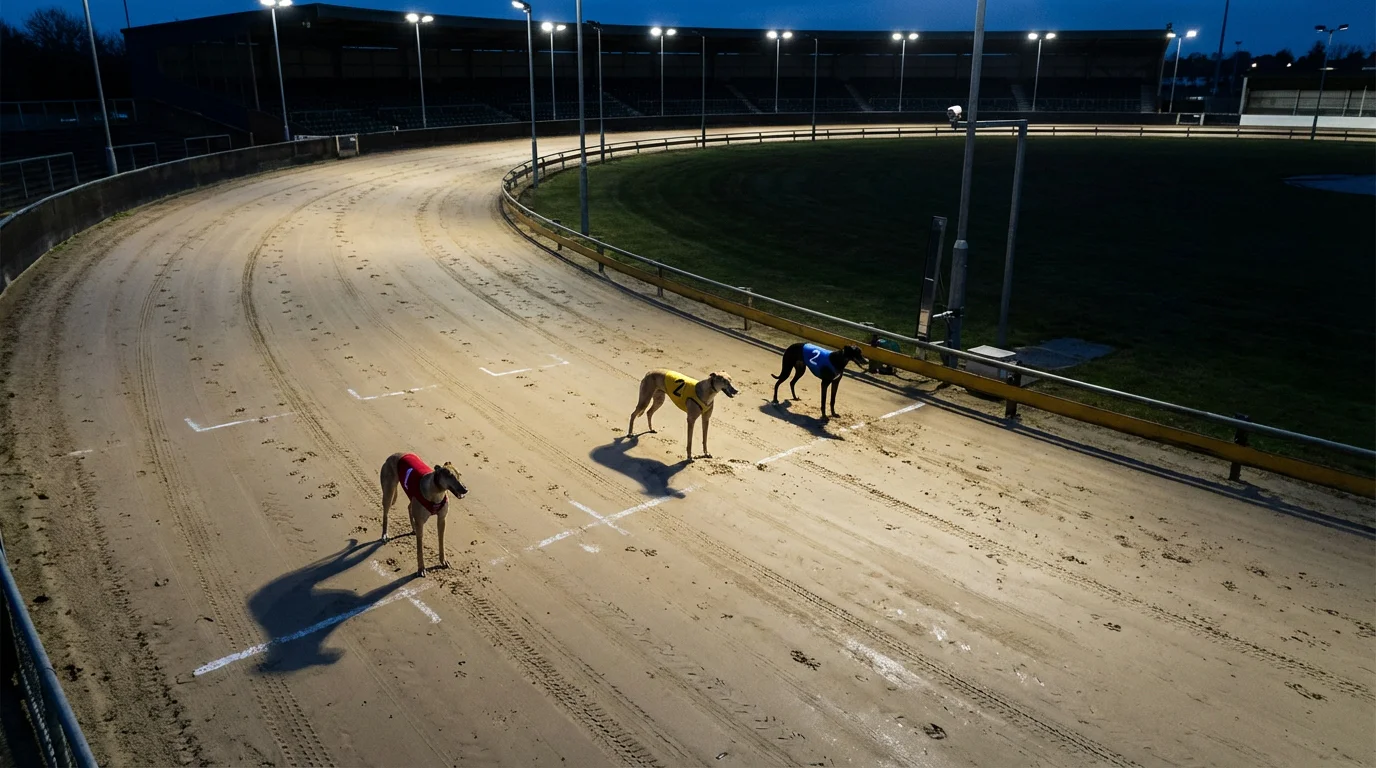
The physical mechanism is straightforward. Instead of a single trap line, the traps are positioned at different distances from the first bend. The front-marker’s trap is closest to the bend; the back-marker’s trap is furthest away. When the traps open, every dog breaks simultaneously, but the front-marker has less ground to cover before reaching the first bend. This head start compensates for the speed difference between the runners, at least in theory.
The yardage gaps between runners are not uniform. A dog rated two grades below the top-rated runner might receive a six-yard start. A dog rated four grades below might receive twelve yards. The racing office calculates these allowances based on a combination of recent finishing times, grade, and the specific track’s distance characteristics. The calculations aim for a photo finish, though in practice the handicapper is working with imperfect data and the results are not always as close as the theory suggests.
For the bettor, the staggered start changes the visual experience of the race. The front-marker reaches the first bend first and often leads for much of the race, but that lead was given rather than earned. The back-marker may be the fastest dog in the field but spends the entire race chasing from behind, trying to reel in the advantage that the handicapper gave the slower runners. Judging whether the back-marker’s superior speed is enough to overcome the yardage deficit is the central analytical question in any handicap race.
One subtlety that many casual punters miss: the stagger affects bend dynamics. In a standard race, all six dogs converge on the first bend from the same starting line, producing the crowding and interference that defines early-race tactics. In a handicap, dogs reach the first bend at different times because they started from different positions. This typically means less first-bend interference, which changes the value of trap draw. The inside traps still have a geometric advantage on bends, but the crowding disadvantage is reduced because the field is more spread out by the time the first bend arrives.
Yardage and Grading in Handicaps
The yardage assigned to each runner is the handicapper’s best estimate of how much head start a slower dog needs to compete with a faster one over the race distance. The calculation is derived primarily from times. If Dog A consistently runs 480 metres in 29.50 seconds and Dog B runs it in 30.10 seconds, the handicapper estimates that Dog B needs roughly three to four yards of head start to compensate for the 0.60-second time difference. One yard translates to approximately 0.06 seconds at greyhound racing pace, so the maths is relatively direct.
In practice, the calculation is more nuanced than raw time comparison. The handicapper considers grade — a dog racing in A3 that runs 29.80 is performing differently from a dog in A6 that runs the same time, because the quality of opposition differs. Recent form trajectory matters: a dog whose times are improving may be underhandicapped if the ratings are based on older performances, while a dog whose times are declining may be overhandicapped. Track-specific adjustments apply too, since the same yardage allowance produces a different real-time advantage on a tight track versus a galloping one.
The grading system interacts with handicapping in a specific way. Most handicap races are restricted to dogs within a defined grade range — for example, A3 to A7. This ensures that the yardage differences remain within a manageable range. A handicap race open to all grades from A1 to A11 would require enormous starting staggers that would undermine the competitive integrity of the race. By restricting the grade band, the racing office keeps the yardage gaps moderate and the races genuinely competitive.
For bettors, the yardage is the key piece of information to interrogate. Ask whether each dog’s allowance accurately reflects its current ability. A dog that has improved since its last few races — perhaps returning from a break, or recently transferred to a better kennel — may be receiving a generous allowance based on outdated times. That dog is effectively getting more of a head start than its current form warrants. Conversely, a dog that ran fast times three weeks ago but has shown signs of declining form may be off a less favourable mark than its recent performances deserve.
Betting on Handicap Races
The betting market for greyhound handicaps tends to be less efficient than for standard graded races, and this is where the opportunity lies. Casual punters often struggle with handicaps because the standard form shortcuts do not apply cleanly. You cannot simply compare finishing times, because each dog covered a different distance. You cannot rely on recent finishing positions, because those results came in graded races with level starts. The disconnect between standard-race form and handicap performance confuses the market, creating pockets of value for the punter who understands the format.
The first principle is to assess each runner on its handicap mark rather than its absolute ability. The best dog in the race is not necessarily the best bet, because it starts from the back mark and must overcome the largest yardage deficit. The question is not “which dog is fastest?” but “which dog is fastest relative to the start it has been given?” A mid-rated dog on a favourable mark — receiving just enough yardage to compensate for its ability gap — often represents better value than the top-rated runner asked to concede significant ground to every other dog in the field.
Track knowledge is particularly valuable in handicaps. The impact of a three-yard head start varies depending on where on the track the stagger is applied. On a track where the first bend comes quickly after the traps, front-markers have a larger effective advantage because they reach the bend first and claim the rail before the back-markers arrive. On tracks with a long run to the first bend, the back-markers have more straight in which to use their superior speed before the first bend compresses the field. Knowing how a specific track’s geometry interacts with the handicap stagger gives you information that the flat starting prices do not always reflect.
Pace analysis takes on extra significance in handicaps. A front-runner on the front mark is doubly advantaged: it starts ahead and its natural racing style consolidates that lead. A closer on the back mark is doubly disadvantaged: it starts behind and its natural style means it will not attempt to recover ground until the later stages. The ideal handicap bet is often a dog with early pace on a mid-to-front mark — fast enough to consolidate its given advantage and hold off the closers who start behind it. These dogs tend to be underpriced relative to the top-rated back-markers because the market overvalues absolute ability and undervalues positional advantage.
Levelled Fields, Tilted Odds
The purpose of the handicap is to produce evenly matched races, but the betting market does not treat them as such. Favourites in handicap races win less often than favourites in standard graded races, because the levelling effect of the stagger compresses the ability gap between runners. This lower favourite strike rate means bigger prices across the board and more scope for overlays on runners the market underestimates.
Handicaps also tend to produce closer finishes and more frequent upsets, which makes them attractive for forecast and tricast bets. When the field is compressed by the handicap, the probability of any specific finishing order decreases — but the probability of an unusual finishing order increases. If you can identify two or three dogs with genuine claims on the race, a combination forecast covering multiple permutations can be productive because the compressed field makes each permutation more likely than it would be in a standard graded race where one dog might be clearly superior.
The punter’s edge in handicaps comes from doing the work that the casual market does not: evaluating the yardage, assessing whether each dog’s mark reflects its current ability, and understanding how the specific track geometry amplifies or diminishes the stagger. It is more analytical effort than a standard race requires, but the payoff is a market that is softer and less well-understood. In a sport where edges are thin, handicap races offer one of the wider margins available.