Best Greyhound Betting Sites – Bet on Greyhounds in 2026
Loading...
The Racecard Is the Menu — Learn to Order
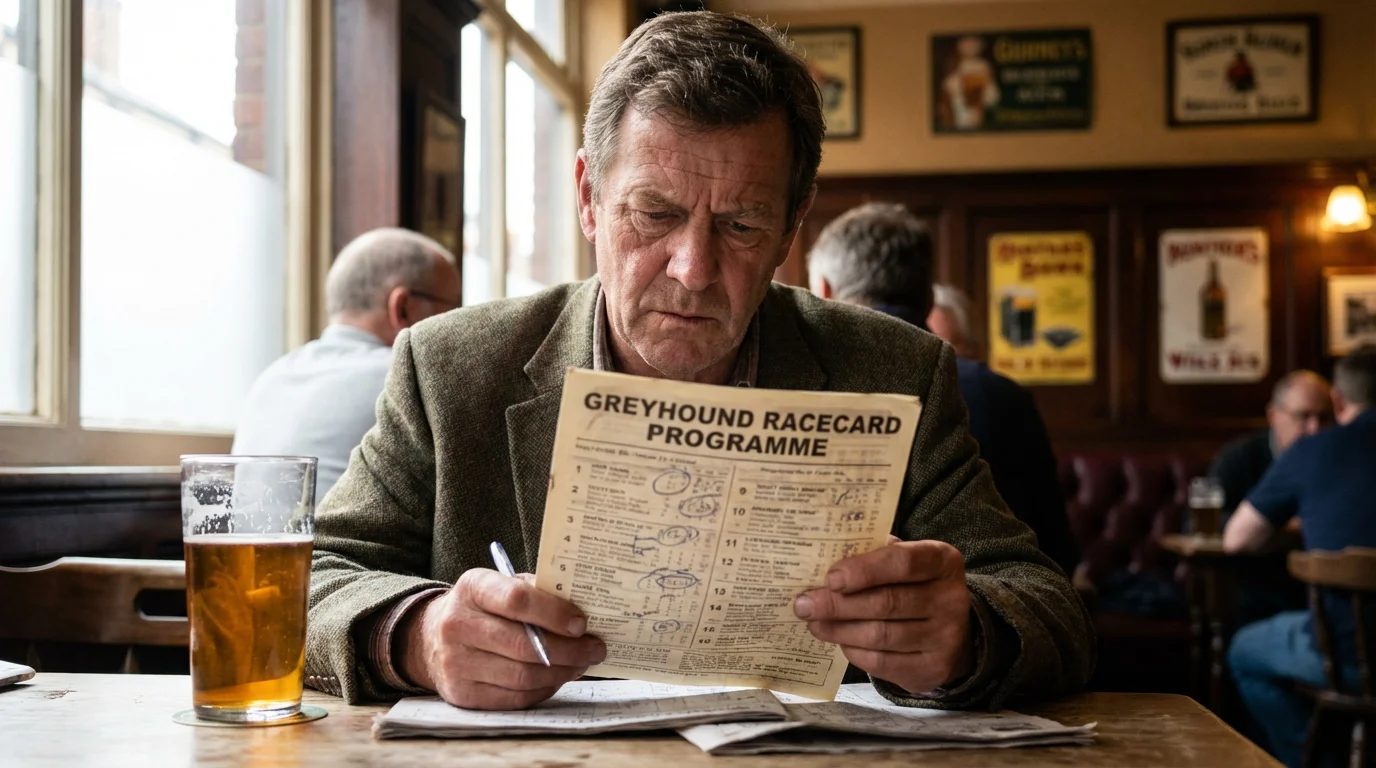
Every winning bet starts with a racecard — and most losing ones start with ignoring it. That’s not an exaggeration. The racecard is the single most information-dense document in greyhound betting, and the punters who learn to read it properly have an immediate advantage over those who glance at trap numbers and prices before following a hunch.
A greyhound racecard tells you the time, the track, the distance, the grade, and the identity of every runner. Then it goes deeper: form figures, recent finishing positions, calculated times, trainer details, weight, age, and — on the better platforms — race comments from the dog’s last few outings. Each piece is a thread. Pull enough of them together and you start to see a picture of what might happen before the traps open.
This guide walks through every element of a standard UK greyhound racecard in 2026, from the header information to the individual runner lines, through the form symbols and abbreviations, and into the sectional times and trap statistics that separate casual punters from serious ones. If you’ve been betting on the dogs using nothing more than the odds board and a gut feeling, this is where you start building an actual edge.
The racecard won’t tell you who’s going to win. No document can. But it will tell you which dogs deserve your attention, which ones are out of their depth, and which races you’d be better off watching from the sidelines with your wallet firmly in your pocket.
Anatomy of a Greyhound Racecard
A racecard packs an enormous amount of information into a small space. Whether you’re viewing it on a results platform like Timeform, in a printed programme at the track, or on a bookmaker’s app, the structure follows a fairly consistent format. Understanding the layout means you can scan a twelve-race card in minutes and quickly identify the races worth studying in depth.
Every racecard divides into two layers. The first is the race header — the macro-level information about the event itself. The second is the runner detail section — the micro-level data for each dog in the field. Both matter, and skipping the header is a mistake that even experienced punters make. Knowing the grade and distance of a race before you look at the form figures changes how you interpret those figures entirely.
Race Header: Time, Track, Distance, Grade
The header sits at the top of each race’s card and typically displays the off time, the track name, the race distance in metres, and the grade or category. In the UK, standard distances range from around 260 metres for sprints up to 900 metres or more for staying events, with 480 metres being the most common standard trip at many tracks.
The grade is arguably the most important single piece of information in the header. UK greyhound racing uses a letter-and-number grading system, with A1 representing the highest class of graded racing and the grades descending through A2, A3, and onwards. There are also open races, which sit above the graded structure and attract the best dogs at a track, plus introductory, puppy, and veteran categories. The grade tells you the quality of the field. An A2 race at Romford features quicker, more consistent dogs than an A6 race at the same track. Form figures from an A6 race don’t translate directly to A2 conditions, and punters who ignore grade context when comparing form are comparing different sports.
The distance matters because dogs specialise. A greyhound that dominates over 480 metres — the bread-and-butter middle distance — may struggle at 640 metres, where stamina and sustained pace replace explosive early speed. The header tells you which type of runner this race will favour, and your form analysis should start from that premise.
Runner Details: Name, Trainer, Weight, Age
Below the header, each runner occupies a row on the card. The dog’s name is listed alongside its trap number and the corresponding colour: Trap 1 (red), Trap 2 (blue), Trap 3 (white), Trap 4 (black), Trap 5 (orange), Trap 6 (black and white stripes). This colour coding is universal across UK tracks and means you can identify any dog during a race from the stands or on a live stream.
The trainer’s name is significant for reasons that go beyond trivia. Certain trainers have notably higher strike rates at specific tracks, either because they know the conditions intimately or because they tend to enter dogs in races that suit their running style. Over time, tracking trainer performance at individual venues becomes a useful supplementary tool in your form analysis.
Weight is listed in kilograms and fluctuates between outings. A consistent weight suggests a dog in stable condition. A significant drop might indicate illness or a change in fitness, while a notable increase could mean a dog coming back from a rest period or being slightly undertrained. Most serious punters don’t act on weight in isolation, but a weight change combined with a dip in form or a shift in running style can tell a story worth noting.
Age is expressed in years and months. Greyhounds typically race between the ages of two and five, with peak performance generally between two and a half and four years old. Older dogs in lower grades may still be competitive — the grading system filters for ability — but a five-year-old stepping up a grade is fighting biology as well as the competition. Conversely, a two-year-old showing rapid improvement has age on its side and room to develop.
Decoding Greyhound Form Figures
Form figures are shorthand for a story — your job is to read the narrative, not just the numbers. On a standard UK racecard, the form line appears as a sequence of digits representing finishing positions in recent races, read from left to right with the most recent run on the far right. A form line of 321142 tells you the dog finished third, then second, then first, then first, then fourth, then second in its last six outings. The trend matters as much as the individual figures.
Looking at that sequence — 321142 — a quick reader would note that the dog was improving (3, 2, 1, 1), then dropped (4), and partially recovered (2). Why the drop? Was it a step up in grade? A different distance? A troublesome trap draw? The form figure gives you the headline; the race details underneath supply the context. The punters who lose money on form reading are often the ones who stop at the headline.
A form line of 111111 looks impressive, but it might belong to a dog that’s been carefully placed in low-grade races by a shrewd trainer. That dog could be about to step up in class, where the competition is sharper and the times are faster. Similarly, a form line of 654532 might look poor until you realise the first four runs were in A1 company and the last two were after a drop to A3 — the dog is coming down in grade, finding its level, and improving. Context reshapes everything.
Numbers aren’t the only characters in a form line. Letters and symbols encode additional information — race absences, non-completions, and other events that affect how you should interpret a dog’s recent history.
Common Form Symbols and Abbreviations
Beyond the finishing position digits, you’ll encounter a standard set of abbreviations. Familiarity with these is non-negotiable for serious racecard reading. The letter F indicates a fall during the race — the dog went down and didn’t finish in a conventional position. This is important because a fall tells you nothing about the dog’s ability; it’s a random event, and a dog returning from a fall in its previous run may well be just as capable as it was before.
The letter T denotes a trap failure — the dog was slow out of the traps or didn’t leave cleanly. A single T in an otherwise strong form line is less concerning than a pattern of them, which could suggest a trapping problem that the trainer hasn’t resolved. B stands for brought down, meaning the dog was interfered with by another runner and couldn’t complete the race normally. Like a fall, it’s informational rather than reflective of ability.
You’ll also see D for disqualified, usually for interference with another dog. A dash or hyphen typically indicates a trial rather than a race, or a period of absence. Some platforms use R for a reserve runner that didn’t take part and V for a void race. The notation isn’t perfectly standardised across all platforms, so check the legend on whichever service you’re using — Timeform, GBGB, or your bookmaker’s racecard — to confirm what each symbol means in that specific context.
The practical takeaway: don’t penalise a dog for incidents outside its control. A form line of 113F21 should be read as 113_21 with one missing data point, not as evidence of inconsistency. The F obscures what might otherwise be a solidly performing animal.
Reading Race Comments and Running Lines
On more detailed racecards — particularly from providers like Timeform or the Racing Post’s greyhound section — you’ll find brief textual comments attached to each previous run. These race comments describe how the dog ran: whether it led from the traps, was crowded at the first bend, finished strongly from off the pace, or faded in the closing stages. They’re the closest thing to a replay in text form.
Running line descriptions typically use shorthand phrases. “Led early, headed entering back straight, kept on” tells you the dog has early pace but may lack the stamina or sustained speed to hold a lead. “Slow away, closed late, nearest at finish” describes a dog that overcomes poor starts through late speed — useful to know if it draws a trap that suits a more patient running style.
The value of race comments is that they add dimension to the numerical form. Two dogs might both have a “2” for their last outing, but one was beaten by a neck after leading for most of the race while the other was never competitive and finished a distant second in a weak field. The numbers are the same; the comments reveal entirely different stories. Where available, always read the comments. They take thirty seconds per dog and can save you from backing a runner whose form looks better on paper than it was in practice.
Sectional Times and Pace Analysis
Calculated times strip away the luck — they show you what a dog can do, not just what happened. Finishing times on their own are useful but incomplete. A dog that wins in 29.52 seconds over 480 metres at Romford has run a quick race, but was it a genuine 29.52 performance or was it aided by a strong pace from another dog that burnt out? Sectional times break the race into segments and answer that question.
The most important sectional in greyhound racing is the split to the first bend, sometimes called the “calculated” or “first sectional” time. This measures how fast a dog reaches the first turn, typically from the traps to a timing point around 100 to 150 metres into the race. Early speed matters enormously in greyhound racing because the first bend is where most crowding and interference occurs. A dog that reaches the bend ahead of the pack avoids trouble and races in clean air for the remainder. The split time tells you whether a dog has genuine early pace or relies on finding room from behind.
The run-home time covers the final section of the race, from the last bend to the finish line. This measures finishing strength. A dog with a slow first sectional but a quick run-home is a closer — it comes from off the pace and finishes strongly. A dog that’s fast to the bend but has a slow run-home is a frontrunner that can be caught if it doesn’t establish a clear lead early. Neither style is inherently better; both can win. The key is matching the running style to the race conditions, the trap draw, and the competition.
Calculated times go a step further. Rather than using raw split times, calculated times adjust for the running position of the dog during the race. A dog running on the outside of the pack covers more ground on the bends than one hugging the rail, so its raw time may be slower despite actually running faster. Calculated times attempt to equalise for this, giving you a more accurate picture of genuine ability. Services like Timeform provide calculated times for most UK meetings, and they’re invaluable for comparing dogs that have raced at different tracks or from different trap positions.
The practical application is straightforward. When two dogs look similar on finishing positions and overall time, check the sectionals. If Dog A has consistently quicker first sectionals, it has a significant advantage in any race where early positioning matters — which, in a tight six-dog field on a sharp track, is most races. If Dog B has the better run-home splits, it’s the one to favour in longer races or at tracks where the bends are more forgiving and late closers have room to operate. Sectional times turn an opinion into evidence.
Track-by-Track Trap Statistics
Every track has its own story about which traps produce and which don’t. Trap statistics are among the most underused tools in greyhound betting, partly because they require effort to compile and partly because casual punters assume the sport is fair enough to make all traps equal. It isn’t. Track geometry, hare rail position, bend tightness, and the run-in to the first turn all create structural advantages and disadvantages for specific box positions.
Take a track with a short run to a tight first bend. At this kind of venue, Trap 1 often has a disproportionately high win rate because the inside rail position lets the dog cut the corner and establish position with minimal effort. The dog in Trap 6, meanwhile, has to cover more ground on the bend and risks being squeezed if the middle traps break quickly. Over hundreds of races, this adds up to a measurable bias. At some UK tracks, Trap 1 wins 20% or more of races — well above the 16.7% you’d expect if all six traps were genuinely equal.
At tracks with longer runs to the first bend, the bias flattens or shifts. A generous run-up gives the outside traps time to cross into a favourable position before the first turn, neutralising the inside advantage. At a few venues, the outside traps actually hold a slight edge because the hare rail curves in a way that favours wider runners. The point is that these biases are track-specific and can’t be assumed — they need to be checked against actual data.
The GBGB publishes results data that can be used to derive trap statistics, and platforms like Timeform provide pre-calculated trap win percentages broken down by track and distance. If you’re betting regularly at a particular venue, compiling your own database from recent results is straightforward and gives you a continuously updated picture. Three months of results — roughly 400 to 600 races at an active track — is usually enough to establish whether a trap bias exists or whether the numbers are just random noise.
How to Use Trap Bias in Your Selections
Knowing that Trap 1 wins 22% of races at a given track doesn’t mean you should back every Trap 1 runner. The bookmakers know the statistics too, and the prices generally reflect the structural advantage. What trap bias data actually helps you do is identify situations where the market hasn’t fully adjusted.
The classic scenario is a dog drawn in a favourable trap that also has strong form but is priced as if the draw doesn’t matter. If a dog with improving form and quick early pace draws Trap 1 at a tight-first-bend track, and the market has it at 3/1 while a less suited dog from Trap 5 is favoured at 2/1, the trap data supports the case that the market is wrong. The trap bias becomes one piece of evidence in a broader argument.
The reverse is also valuable. If you fancy a dog on form but it’s drawn in a demonstrably poor trap at the track in question, that’s a reason to reduce your stake or skip the race altogether. The form might be good, but if the draw is working against the dog, the probability of it performing to its best is diminished. Trap statistics don’t override form analysis — they refine it. They’re the filter that turns a decent selection into a sharper one, or a marginal selection into a pass.
Putting Form in Context — Grade, Going, and Gaps
Raw form without context is noise. A dog’s recent results only tell you something useful when you understand the conditions under which those results were produced. Three key contextual factors determine how much weight you should give any piece of form: the grade of the races, the going, and the gap between runs.
Grade context is the most important and the most frequently ignored. A dog that has been finishing second and third in A2 races may look weaker on paper than a dog winning in A5 — but the A2 runner is competing against significantly faster, more experienced dogs. If the A2 dog drops to A3 or A4, it becomes a serious contender. Conversely, a dog with a string of wins in A7 that gets bumped up to A5 may find the step up in quality too sharp. Always check the grade next to each form figure, not just the finishing position itself.
Going — the track surface condition — matters more than many punters realise. UK greyhound tracks are predominantly sand-based, but surface conditions change with weather. A wet track runs slower and can affect dogs differently depending on their running style and physical build. A heavier-set dog with a grinding, staying style may actually improve on a rain-affected surface, while a lighter speedster might lose its advantage. Going reports aren’t always published as consistently in greyhound racing as in horse racing, but noting the weather conditions at the time of recent runs gives you a rough gauge.
Gaps between runs are the third pillar. A dog that hasn’t raced for three or four weeks may be returning from injury, being rested after a busy spell, or being freshened up for a specific target race. In any case, the rustiness factor is real. Most greyhound trainers like their dogs running regularly — every four to seven days — to maintain sharpness. A longer absence should make you cautious, particularly if the dog’s pre-break form was patchy. On the other hand, a dog returning from a planned rest after good form might be coming back at peak condition, especially if it’s been trialled recently (indicated on the card by a trial time or notation).
Bringing these three factors together is what separates form reading from form glancing. The punter who sees “2, 3, 1, 2” and concludes “consistent, worth backing” is doing half the job. The punter who sees “2 in A2, 3 in A1, 1 in A3, 2 in A3 — now running A4 on a track it’s tried once and won at, with seven days since its last outing” is building a case that has actual predictive weight.
When the Card Tells You to Walk Away
The best use of a racecard isn’t always finding a bet — sometimes it’s seeing there isn’t one. This is the hardest lesson for regular greyhound punters to internalise, because the instinct is to act. Twelve races on an evening card, each one a chance to back something, and the temptation to be involved in all of them is powerful. But the racecard, read properly, will tell you which races are genuinely bettable and which are coin-flips that no amount of form study can resolve.
There are reliable signals. A race where every dog has inconsistent form and frequent trap or positional problems is a race without a clear standout — the kind of event where the winner is determined more by the run of the race than by any inherent superiority. A race where the favourite’s form was all achieved at a different track, over a different distance, and in a different grade is one where the market might be overvaluing reputation and undervaluing the unknowns. A race where a key dog has been absent for weeks with no public trial time is carrying risk that isn’t reflected in the price.
Walking away from a race isn’t a sign of weakness or lack of knowledge. It’s the opposite. It’s evidence that you’ve read the card, assessed the information, and concluded that your edge in this particular event is insufficient to justify risking money. The punters who grind out long-term profits from greyhound racing are not the ones who bet on every race. They’re the ones who bet on seven or eight races out of fifty in a week and do so with genuine conviction backed by evidence from the card.
The racecard is a tool. Like any tool, it works best when you know not just how to use it, but when to put it down. If the card doesn’t give you a clear reason to bet, it’s giving you a clear reason not to. Listen to it.